

Bennett Stirtz Scouting Report
Evaluating the Former D-II Product's Skill Set and NBA Translation
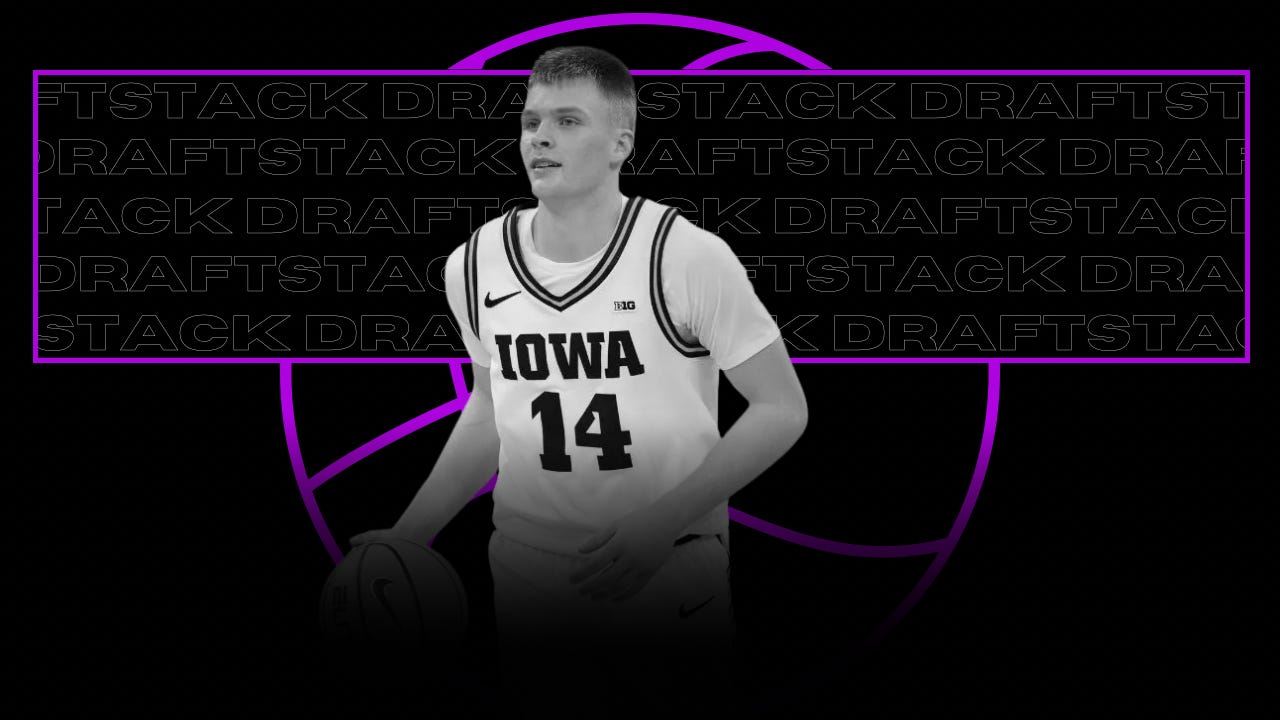
Before bursting onto draft radars at Drake University, Bennett Stirtz was an absolute stud at Northwest Missouri State, where he averaged 15.2 PPG as a sophomore and led the MIAA in assist-to-turnover ratio during the 2023 season. At Drake, Stirtz elevated his production, posting 19.2 PPG and shooting 49.8% from the field. Now at Iowa, the Liberty, Missouri native has continued his upward trajectory, averaging 18.4 PPG, 4.9 APG, and 2.6 RPG on an efficient 47.6 FG%, while also adding 1.5 SPG. Stirtz is a unique point guard prospect. His long-time coach, Ben McCollum—who has been with him at every stop—prefers to slow the game down and maximize every possession. That philosophy is reflected in the Hawkeyes’ pace (357th in possessions per game and 334th in adjusted tempo). Stirtz’s combination of perimeter scoring, elite feel, and experience makes him a versatile floor general ready to contribute to NBA systems that value efficient, quality looks on every possession. From here, we’ll assess his strengths, growth opportunities, and pro-level projection.
Player Bio
Height- 6’4” (Tankathon)
Weight- 190 lbs. (Tankathon)
Wingspan- N/A
Standing Reach- N/A
Draft Age- 22.71
Position- Point Guard
Nationality- American
Intangibles
Controlled Chaos: Stirtz remains consistently calm under pressure, displaying impressive poise. He rarely forces plays, keeps his team on schedule, and is tasked with handling pressure from aggressive defenders on a nightly basis—a true floor general.
Consistent Demeanor: Never fazed by a tough game individually. Strong confidence in his ability to knock down shots from range and he is always looking to make an impact. He hasn’t been a liability, even during challenging games where he is not at his best.
Basketball Intelligence: IQ is Stirtz’s trademark. His decision-making out of the pick-and-roll, shot selection, and understanding of timing and angles make him so intriguing as an orchestrator of an offense. This awareness carries over defensively, where his active hands and positioning allow him to make an impact without him being a special athlete. Stirtz is essentially programmed to make the right play every time he touches the ball.
Key Takeaways: Stirtz is a standout point guard prospect whose feel is among the best in this class—a trait NBA teams highly value in a lead guard. Tempo control, awareness on both ends, and reliability as a handler make him an immediate contributor at the next level and position him to be selected in the late first round.
Scoring & Playmaking Profile
Perimeter Shot-Making: Drastic strides as a shot-maker beyond the arc. While he is comfortable playing off the ball, the fact that only 38.6% are assisted highlights his ability to create his own offense from deep. He generates looks via step-backs, one-dribble pull-ups out of ball screens, and hesitation pulls when a big is switched onto him. Improved volume and sustained efficiency (7.7 3P/100 on 39.6% → 10.1 3P/100 on 37.3%).
Pick-and-Roll Virtuoso: Stirtz’s offensive fastball comes out of the pick-and-roll. Whether he’s hitting the short roll, pulling up to score, or simply keeping the offense flowing, the Iowa point guard routinely makes advanced reads in this scenario. He is a highly reliable passer capable of throwing lobs, zipping skip passes off a live dribble, or getting downhill to kick it out to the corner. He also takes excellent care of the ball (26.5 AST%, 14.2 TO%, 2.3 A/TO) further underscoring his efficiency as an initiator.
Interior Craft + Pace: Displays subtle, yet effective change-of-speed when attacking the rim. Despite athletic limitations, Stirtz does find ways to get all the way to the rack with inside-hand scoops, wrong-foot finishes, and two-foot gathers in the paint while utilizing shot fakes to create just enough space to convert. His pace shows up often in the half-court—particularly out of handoffs and ball screens—where he sprints off the screener’s shoulder to get downhill and create advantages for himself and others. He is currently finishing 69.2% of his attempts at the rim, with only 35.6% of those finishes being assisted, pointing to some signs of self-creation.
Off-Ball Value: While Stirtz shoulders almost all of the table-setting duties for the Hawkeyes, his off-ball utility projects cleanly to the NBA level. This season, he’s taken on increased work away from the ball, knocking down catch-and-shoot threes, making timely cuts, and spacing the floor with his gravity. Given his established playmaking prowess, it’s encouraging to see him comfortable attacking closeouts and functioning as a second-side handler. That adaptability is an underrated trait for any guard prospect.
Key Takeaways: Bennett Stirtz’s offensive foundation is built upon his playmaking. The versatility as a passer, advanced timing, and strong command of the position make him an enticing option for playoff teams towards the end of the first round seeking a floor general. However, the significant steps as a shot-maker and overall scorer are what elevate his ceiling into legitimate top-20 to lottery consideration. He profiles as a true dual-threat point guard, capable of serving an offense while also generating scoring pressure in multiple ways—both on and off the ball.
Areas for Growth & Concerns
Overall Athleticism/Defense: At the NBA level, Stirtz projects to be a below-average athlete. He lacks the vertical pop and twitchy stop-start burst common among many NBA guards, which could make him a target defensively early in his career. Despite a strong career steal rate (3.1%), he will be challenged by quicker perimeter creators and may need some schematic protection. That said, his anticipation, quick hands, and positional awareness give him value as a team defender, and proper usage could maximize his impact on this end of the floor. While he isn’t as physically gifted as many of his future draft peers, his defensive effectiveness will rely on his intelligence and connectivity rather than his athletic profile.
Advantage Creation: Currently depends heavily on screens to generate consistent quality looks. While Ben McCollum’s system is built on movement and layered screening, Stirtz does not consistently create downhill advantages on his own when opportunities present themselves. This limits his overall shot-creation and stems primarily from a lack of burst and physicality as a driver—traits that could put a cap on his scoring upside in the league.
Limited Ceiling: Stirtz will be 23 years old on opening night for the 2026 NBA season, which naturally limits his long-term upside. However, his game is built on feel, decision-making, and efficiency rather than superb athletic traits, giving him a clear and reliable NBA translation. This does not eliminate future improvement though—added strength and improved flexibility could enhance his handle and creation, allowing his game to scale another level.
Key Takeaways: Bennett Stirtz will not be drafted for physical tools or raw talent, but for the idea of him being stepping in right away to affect the team in a positive way on the offensive end. While his self-creation ceiling is capped by his average burst, physicality, and reliance on screens to generate advantages, his perimeter shot-making, production within structured systems, and high-level processing on both ends of the floor make him an attractive option for playoff teams seeking reliability in their backcourt.
Base Statistics & Advanced Metrics (BartTorvik)
Legend: TS% = True Shooting Percentage | BPM = Box Plus-Minus | FTR = Free Throw Rate | USG% = Usage Rate | 3PA/100 = Three-Point Attempts per 100 Possessions
*Senior Year Numbers* *20 Games Played So Far*
18.4 PPG - 4.9 APG - 2.6 RPG - 1.5 SPG - 0.2 BPG - 2.1 TOPG
47.6 FG% - 37.3 3FG% - 83.7 FT% - 36.0 MIN
61.2% TS - 8.3 BPM - 38.6 FTR - 25.4% USG - 10.1 3PA/100 Possessions
NBA Projection & Player Comp (Style)
Bennett Stirtz projects as a reliable offensive organizer with an expanding shot-making arsenal, capable of providing high-level stabilizing value to a second unit early in his career, with a pathway to becoming a dependable starting lead guard on a contending team. His value is rooted in game management, playmaking, and increasingly consistent shot-making rather than athletic-driven advantage creation. In playoff environments, he profiles as a trustworthy ball-handler who can run offense, protect possessions, and punish coverage mistakes on or off the ball.
While Stirtz has the feel and versatility to function in a wide range of offensive systems, his development under Ben McCollum came in an extremely deliberate, half-court-oriented offense built around tempo control, constant movement, and layered screening actions. That ecosystem requires him to sprint off handoffs and ball screens while maximizing each possession, quite the opposite of the NBA game where most teams prioritize tempo and space. The transition should be manageable, however, given Stirtz’s processing and portability. The Minnesota Timberwolves stand out as a strong organizational fit, running an offense centered on pace (13th in the NBA), player movement, and read-and-react principles. Stirtz could stabilize Coach Finch’s second unit while also alleviating pressure for their franchise player in Anthony Edwards.
Stylistically, Stirtz gives off early-2000s point guard vibes, most notably Kirk Hinrich. Hinrich was a key piece of the Chicago Bulls’ playoff success during the Derrick Rose era, providing reliability, perimeter shot-making, and connective value in both starting and bench roles. The Iowa native, Hinrich shares several traits with the current Hawkeyes guard—specifically on/off-ball scalability, feel as a passer, and dependable shooting from the perimeter. Hinrich entered the league at 23 years old, as Stirtz will, and neither profile as primary creators. However, Stirtz could follow a similar trajectory to the former Kansas Jayhawk: a high-IQ sparkplug capable of anchoring second units while scaling up into a heavier workload when team context requires it.
Final Evaluation
Iowa Hawkeyes workhorse Bennett Stirtz is one of the more impressive point guard prospects in the 2026 NBA Draft. His offensive toolkit—highlighted by improved perimeter shot-making, nuanced passing, and advanced pick-and-roll navigation positions him well for long-term success at the NBA level. Despite carrying a heavy on-ball burden, his growing effectiveness off the ball this season has stood out and should only raise his draft stock. While limited athleticism may cap his ceiling as a self-creator and defender, Stirtz’s intelligence, feel for the game, and competitiveness make him a strong bet to at least carve out a meaningful role on a playoff-caliber team. Scouts will continue to monitor how he performs against higher-level competition, but he should remain firmly in first-round consideration. His game resembles his collegiate journey—resilient, adaptable, and built for winning moments. Simply put, he’s a gamer.