

Dailyn Swain Scouting Report
Analyzing the First-Round Potential of Texas’ Point-Forward
Texas star point-forward Dailyn Swain, a former Xavier transfer, stepped into a featured role in his first season with the Longhorns and emerged as the primary driving force behind the program’s deep March run. Across 35 appearances, Swain averaged 17.3 points, 7.5 rebounds, and 3.6 assists per game while posting efficient shooting splits of 57.8% EFG, 34.8% from three, and 81.3% from the free-throw line. A versatile offensive weapon, Swain thrives as a downhill-oriented isolation scorer who can collapse defenses, create interior looks for teammates (3.3 rim assists per 100), and convert with touch below the three-point line. Combined with his defensive playmaking tools, the analytical profile points toward legitimate upside as a star wing initiator at the next level. Still, concerns surrounding his ball security and occasional reluctance to fire from deep raise an important question: can this playstyle truly translate at the NBA level? Let’s break down his game.
Player Bio
Height - 6’6.5” (NBA Combine)
Weight - 211 lbs. (NBA Combine)
Wingspan - 6’10” (NBA Combine)
Standing Reach - 8’8.5” (NBA Combine)
Draft Age - 20.9
Max Vertical - 36.5 in. (NBA Combine)
Position - Wing
Nationality - American
Schools Attended - Xavier, Texas
College Comparisons
Swain possesses one of the more intriguing statistical profiles in the class, blending high-usage offensive responsibility with efficient inside-the-arc scoring and defensive playmaking tools. While his breakout season at Texas showcased his ability to shoulder a much larger offensive role, his Xavier tape also highlighted how impactful he can be in a more scaled-back, off-ball environment where his defensive activity truly pops. Even with the heavier workload for the Longhorns, Swain still provided positive defensive value, though not quite to the same disruptive level he displayed at Xavier.
Here are a few BartTorvik queries that help illustrate the type of archetype Swain may fit at the next level, while also providing context for where his analytical profile stacks up historically.
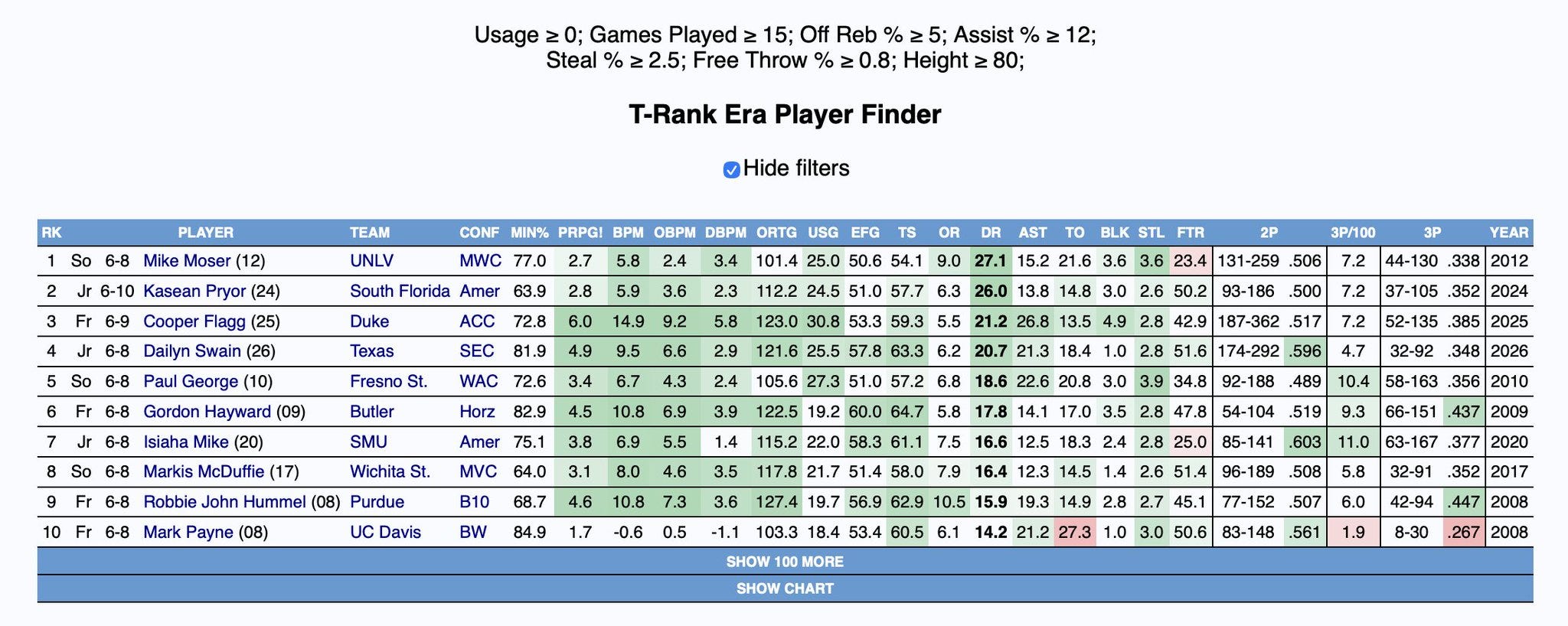
Query: Players with ≥15 GP, ≥5% OREB, ≥12% AST, ≥2.5% STL, ≥80 FT%, and height ≥80 inches.
Credit to SheedinATL's Substack


At least for me (Sheed too of course), this is what makes Swain a lottery-caliber prospect. The ancillary production provides real evidence that he could thrive in a lower-usage, off-ball role early in his NBA career, which would likely help minimize some of the turnover concerns while still allowing his self-creation flashes to surface in more selective opportunities. That pathway — impactful complementary piece with room for on-ball growth — is extremely valuable.
The main concern with this query — particularly when it comes to Swain — is the lack of three-point volume. I’ll dive deeper into that shortly, but it’s an area that almost certainly has to scale upward at the NBA level for him to fully maximize this archetype.
Highly recommend checking out that X link above as well. Excellent work!
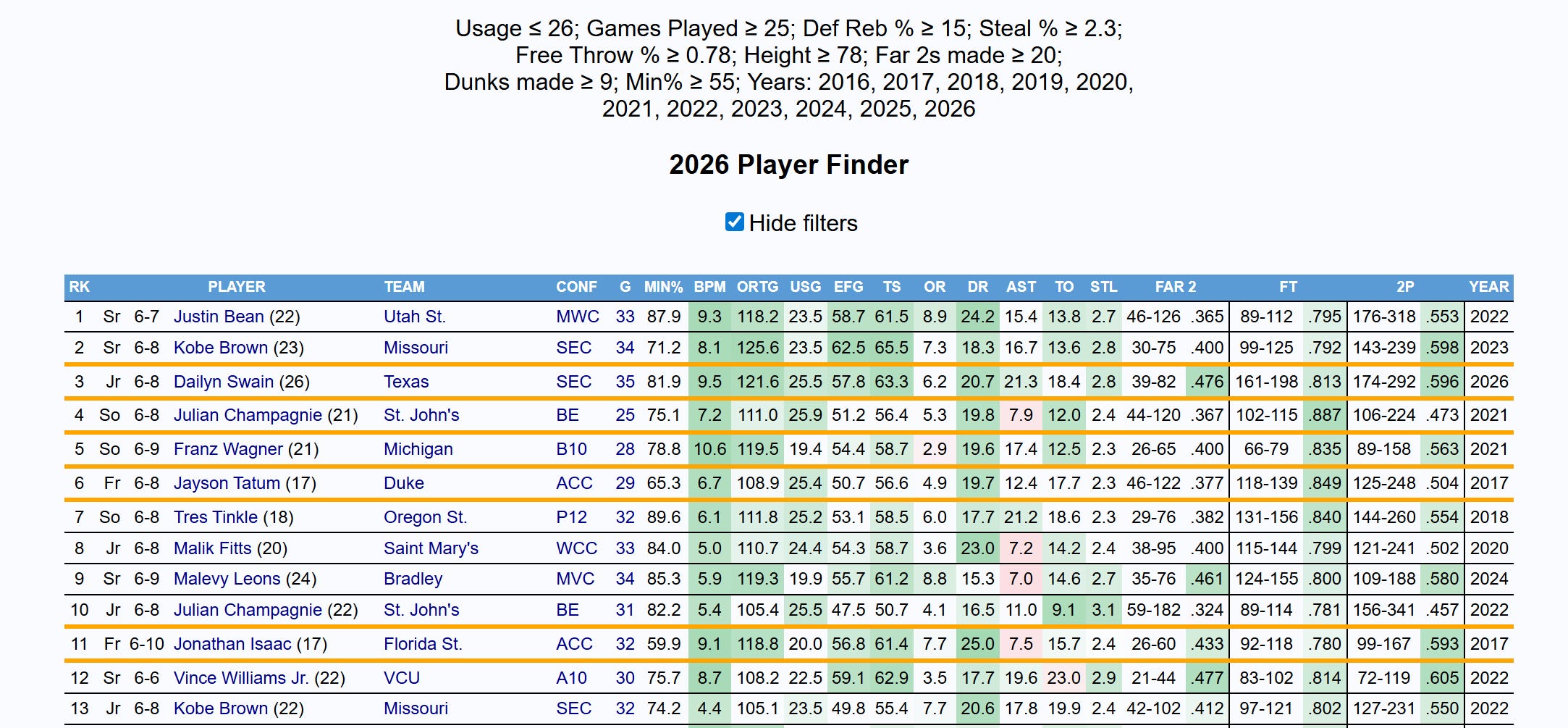
Photo via BartTorvik
Query: Players with Usage ≤ 26, GP ≥ 25, DRB% ≥ 15, STL% ≥ 2.3, FT% ≥ 0.78, Height ≥ 78, Far 2PM ≥ 20, Dunks ≥ 9, Min% ≥ 55, Seasons 2016–2026
The two players who stand out from this statistical query are Jayson Tatum and Franz Wagner. Both are highly impactful wing creators who contribute on both ends of the floor, while also providing strong complementary value as rebounders, defensive playmakers, and above-average athletes (as reflected in dunk volume).
Tatum represents the clear standard for this archetype at the position, functioning as a primary offensive engine with two-way versatility. Wagner, meanwhile, profiles more as an elite connective wing who has shown in extended stretches the ability to elevate into a higher-level offensive role while still maintaining consistent defensive impact. Both are rare, winning-impact players with scalable skill sets.
This is also an encouraging framework for a prospect like Swain. Much like Wagner, who entered the league after multiple college seasons, Swain is developing along a similar multi-year track. There is a clear developmental blueprint here for him to grow into a high-level role player with creation upside, with a realistic pathway toward becoming a star-level connective wing if his offensive game continues to expand.
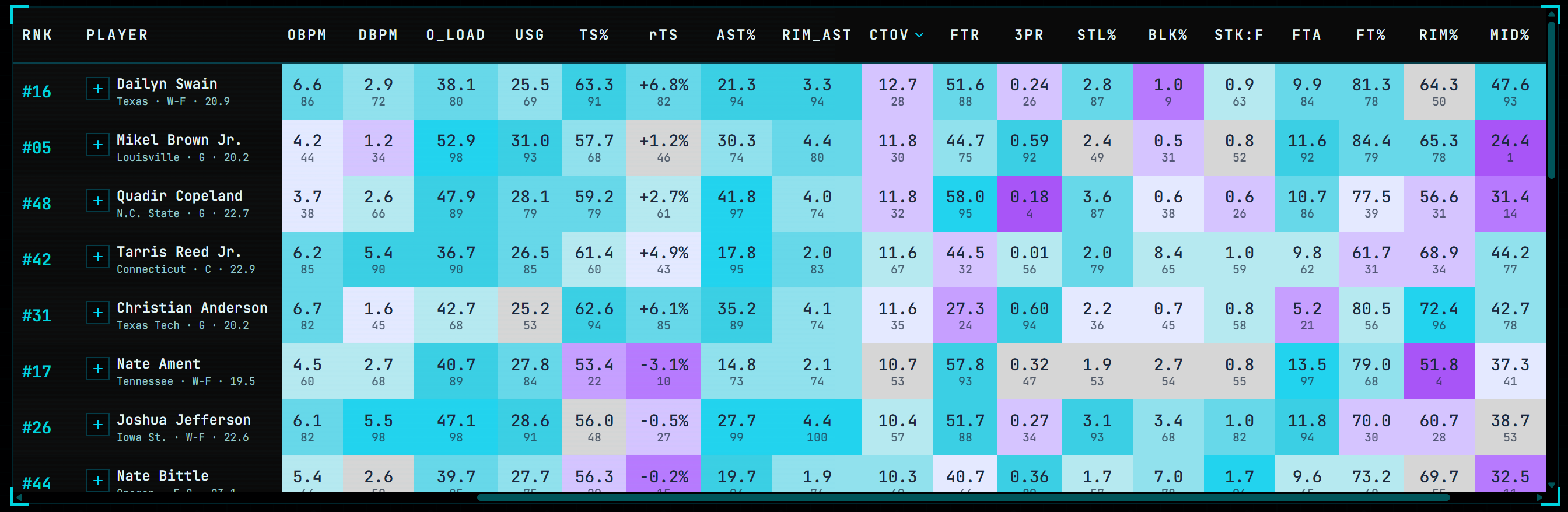
Photo via DraftBallr
Among players on DraftBallr’s draft board with a 25% usage rate, Swain posted the highest Creation Turnover % (CTOV).
This isn’t meant to take away from Swain’s upside as a potential NBA creator, but it’s still an area worth noting. He had a negative impact on his team’s turnover economy, largely tied to his reluctance to consistently attempt threes. That hesitancy at times stagnated an already half-court–heavy offense and led to more forced drives into loaded help defenses. While Texas as a whole already wasn’t a high volume shooting team last season, Swain likely could have helped alleviate some of those spacing issues simply by being more willing to let it fly from deep.
Creation Turnover % - Ben Taylor’s adjusted turnover rate that accounts for playmaking burden. Uses Offensive Load instead of Usage to fairly compare creators vs. finishers.
FORMULA: TOV / Offensive Load
Athletic Profile & Defensive Impact
Fluid Athleticism + Frame: Possesses an NBA-ready frame paired with advanced movement skills as a ball-handler. He glides downhill with long, efficient strides, using a variety of shifts and changes of pace to slip past defenders, while also bringing enough vertical burst to finish emphatically above the rim (25 made dunks last season). That same fluid athleticism translates on the defensive end, where he flashes strong shot-blocking ability and generates turnovers at a solid rate within a reduced role.
Defensive Playmaking: His prominent on-ball role at Texas somewhat suppressed the counting stats (2.8 STL%, 1.0 BLK%), but Swain has clearly shown he can function as a disruptive defensive presence. That was especially evident during his sophomore year at Xavier, where he posted a 3.2 STL% and 2.3 BLK%, signaling a higher level of engagement and event creation on that end. That level of activity wasn’t as consistent at Texas at times, but the underlying defensive instincts remain intact. Expect him to earn early rotation minutes as a way to reestablish that impact and provide defensive energy at the next level.
Positional Rebounding: I wouldn’t label him an excellent offensive rebounder (6.2 ORB%), but for a wing, his defensive rebounding rate stands out at 20.7%. He uses his athleticism well to finish possessions on that end, and his ability to secure the board and immediately push the break himself adds real value in transition.
Key Takeaways: As I previously mentioned, Dailyn Swain’s ancillary production is what elevates his profile to a lottery-level talent in my eyes. His stock generation speaks directly to his defensive athleticism, while his rebounding for the position is comfortably above average. He can be that Swiss Army knife-type wing who can consistently impact the game in a variety of ways without needing the ball in his hands to be effective.
Scoring & Playmaking Profile
Self-Created Rim Pressure: A truly impressive isolation scorer downhill within a half-court–heavy system at Texas. Swain generated 10.5 rim attempts per 100 possessions (92nd percentile), with 82% of those looks coming unassisted. He consistently created paint touches through relentless pressure, finishing 64.5% at the rim (50th percentile). Swain leverages strong body control, a fluid handle, and above-average athleticism to navigate downhill traffic, generate quality rim attempts for himself, and create for teammates as well—reflected in his 3.3 rim assists per 100 possessions (94th percentile).
Credits to @HoopKeese on X
 Chris Keesee (NBA Scouting)@HoopKeeseeDailyn Swain and Labaron Philon are skyrocketing in my rankings. There were only 3 players that: 1) Self-created more than 71% of their FGM 2) Shot above 50% from the field. Among High Major Players in the top 100 in FGA (Bart) These are the 3 best creators in the draft
 6:31 PM · May 25, 2026 · 35K Views2 Replies · 8 Reposts · 40 Likes
Heavy Workload: The catalyst of Texas’ half-court–dependent scheme, Swain carried a 38.1 Offensive Load (Evolution of Usage Rate), an 80th percentile mark, reflecting his heavy responsibility as a primary creator. He was relied upon for the majority of the Longhorns’ shot creation within a system that finished 19th in adjusted offensive efficiency despite being an average shooting team at best and ranking 254th in three-point rate. Most of Swain’s offensive usage came in the half court, though he remained efficient in transition as well, converting those opportunities at 1.28 PPP on 17.4% frequency.

Key Takeaways: Swain will likely not be tasked with this level of offensive workload early in his career, but the volume and quality of self-created looks is still impressive, especially given the type of offensive environment he operated in.
Areas for Growth & Concerns
Three-Point Hesitancy + Consistency: While Swain’s scoring profile is impressive, his lack of consistent three-point willingness within the flow of the offense hurt Texas at times and could similarly limit spacing at the NBA level. He attempted just 4.6 threes per 100 possessions while converting 34.8% — a respectable percentage on the surface, but the volume needs to rise. There are indicators that point toward him becoming at least an average NBA shooter (81.3% FT, 47.6% from mid-range), though his release is somewhat slow and his shot preparation remains inconsistent. Considering he’ll likely begin his career in more of an off-ball role, developing the confidence and readiness to fire on open catch-and-shoot opportunities will be important.
Ball Security: As mentioned earlier, Swain’s negative turnover influence is closely connected to his hesitancy from beyond the arc. Texas put the ball in his hands extensively, so part of it may have been a mindset issue where he defaulted toward driving or creating rather than confidently taking open threes. That tendency often impacted his turnover rate, particularly in self-creation situations. At times, he would get too deep into the paint and force difficult reads, leading to some questionable decisions as a primary initiator that raise legitimate questions about his long-term projection as a wing creator. His 12.7 CTOV% (Creation Turnover %) was the highest among likely draft picks — far from ideal — though there is reason to believe it could improve in a smaller offensive role with less on-ball responsibility.
Key Takeaways: Swain does have some clear flaws within the context of a potential “star wing” archetype, particularly with his three-point volume and turnover issues, but neither should be significant enough to scare teams away on draft night. Even if he never fully reaches his ceiling as a primary creator, the combination of his physical tools, feel, and overall production still gives him a strong foundation to become a highly impactful role player. The swing skill will simply come down to improving his confidence from deep while continuing to find ways to cut down on the turnover numbers.
Base Statistics & Advanced Metrics (DraftBallr)
Legend: TS% = True Shooting Percentage | BPM = Box Plus-Minus | FTR = Free Throw Rate | USG% = Usage Rate | 3PA/100 = Three-Point Attempts per 100 Possessions
*Junior Year Numbers* *35 Games Played*
17.3 PPG - 7.5 RPG - 3.6 APG - 0.3 BPG - 1.6 SPG - 2.8 TOPG
54.2 FG% - 34.8 3FG% - 81.3 FT% - 32.8 MIN
63.3% TS - 9.5 BPM - 51.6 FTR - 25.5% USG - 4.6 3PA/100 Possessions
Stylistic & Analytical Comparisons
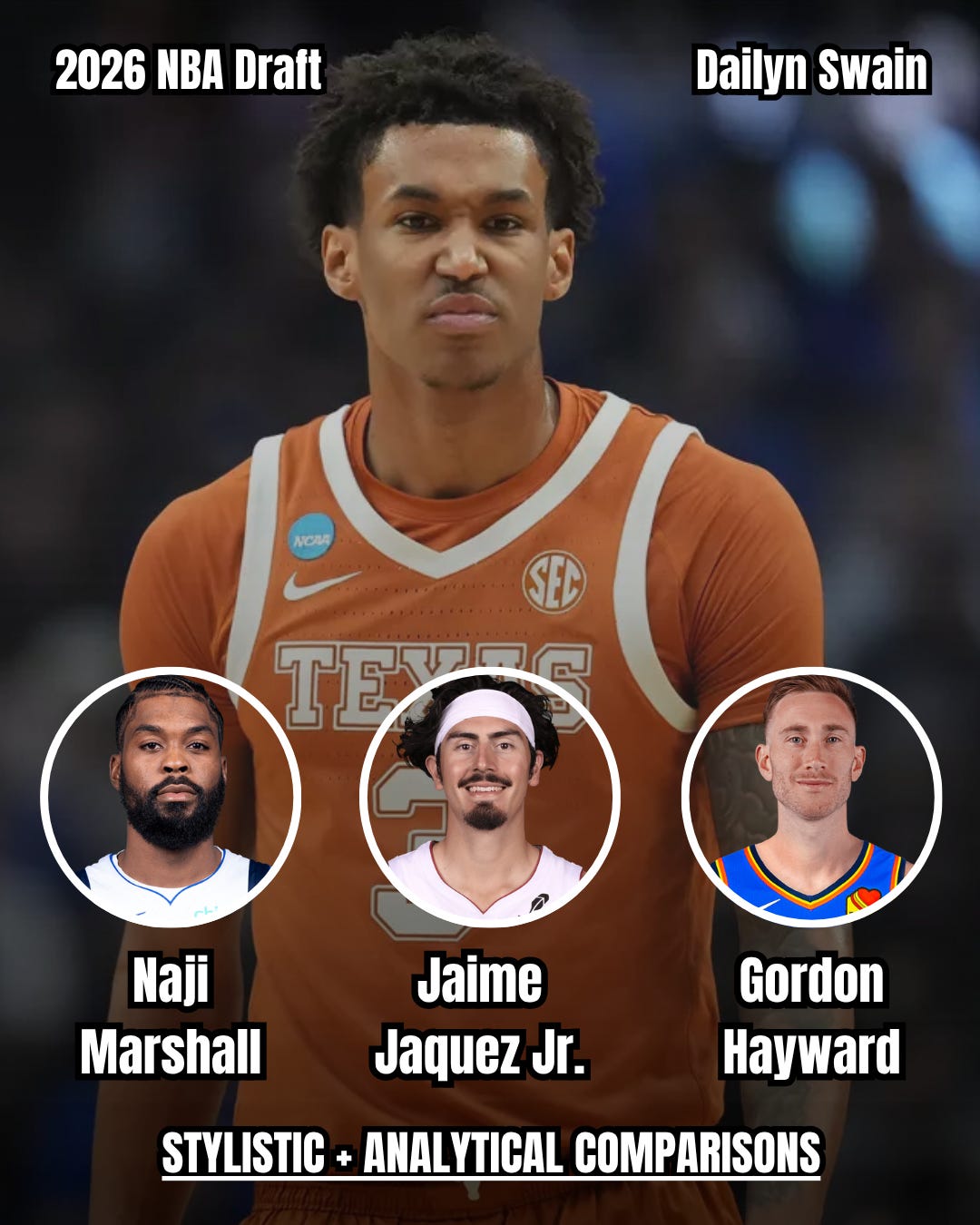
I know I mentioned Wagner and Tatum earlier in the report, but those comparisons were more about illustrating Swain’s scalability and two-way impact ceiling rather than serving as direct stylistic projections.
No disrespect to Naji Marshall, but that’s closer to the low-to-medium end outcome I envision for Swain. A versatile Swiss-army-knife forward who can pressure the rim, make smart reads, and generate defensive events, but never fully develops into a reliable high-volume three-point shooter.
Jaime Jaquez Jr. is another interesting comparison. Swain posted a 66.3% similarity score to Jaquez on the DraftBallr site, and the overlap makes sense stylistically. Both are downhill-oriented drivers who rely on craft, physicality, and touch around the rim more than pure explosiveness. I could definitely see a version of Swain developing into that type of player, potentially with a little more passing upside.
Gordon Hayward (Utah era) might be the most intriguing comparison of the group. Swain carries an 84.0% similarity score to Hayward on the site, and when you go back and watch the old Utah film, some of the similarities do pop. Strong, fluid downhill driver, capable of finishing through or over defenders, while also impacting the game defensively with size and feel. Physically, this is probably the closest comparison as well. Hayward was never viewed as a pure sniper, but during his best Utah season he still attempted 5.1 threes per game while converting just under 40% — the type of volume and efficiency combination you’d ideally like to see Swain eventually grow into.
Player comparisons are always difficult, and I generally do not put too much stock into them as definitive projections, but they are still a fun and useful exercise for visualizing different developmental pathways.
Final Evaluation
Dailyn Swain is one of “My Guys” in the 2026 NBA Draft. A high-volume isolation scorer with a PhD in getting downhill, Swain’s intersection of athleticism, handle, and scoring touch is enough for me to buy into the potential “star wing” outcome. Even if he never fully reaches that ceiling, this is still a lottery-level talent in my eyes.
Early in his career he projects as a versatile, do-it-all wing capable of making plays defensively, generating offense in self-creation situations, and creating opportunities for teammates. What makes Swain especially intriguing is that he fits the rare archetype of a player who can thrive as an impactful role player while still possessing legitimate scalability toward becoming a primary creator.
Of course, the two biggest concerns are the three-point willingness and turnover numbers, both of which will need improvement as he transitions to the NBA. Still, Swain is absolutely a player I would feel comfortable selecting in the lottery, and I believe he deserves significantly more buzz than he is currently receiving. He’s a stud.