

Keaton Wagler Scouting Report
In depth breakdown of one of the highest risers in the 2026 NBA Draft
Every draft cycle produces at least one prospect who starts the year absent from draft conversations and finishes it as one of the hottest commodities in the class. Recent examples like Bub Carrington, Noah Clowney and Jeremiah Fears all followed that path, rising from relative obscurity to lottery conversations in a matter of months. This year, Keaton Wagler threw himself into that pool of players in one of the more unusual ways we have seen in recent memory. All of the names I previously mentioned were, at worst, four-star recruits ranked comfortably inside the top 100 by most recruiting services. Wagler, meanwhile, was ranked by just one website. Yes, the same guy who is now seen as a lock to be a top-10 pick was unranked by virtually every outlet as a high school recruit.
Despite that, it didn’t take long for Wagler to make himself known, as rumblings about him began to circulate almost the moment Illinois started summer workouts. Wagler quickly proved those rumblings were warranted, establishing himself as one of the most tantalizing freshmen in the country right out of the gate. As a result, I jumped on the opportunity, writing about him in just my second player profile of the year all the way back in November. Fast forward to now, and Wagler is still one of, if not my favorite prospect in this draft and finds himself firmly in the top four of my board. That may be a bit high for some, but I think I can make a compelling case as to why I believe that, and as always, let’s start with the physicals.
Physicals:
Going to be Captain Obvious here for a second and say that the NBA likes size, particularly at the guard position. Now, I do not associate myself with the group of believers who think small guards are a dying breed, but it is undoubtedly harder to build a team that relies heavily on the production of a player under 6-foot-3. Luckily for Wagler — and whatever team drafts him — that won’t be a concern, as he measured in at 6-foot-5 barefoot with a not-as-impressive, but still solid, 6-foot-6¼ wingspan. His weight of 188 pounds is by no means ideal, especially for a player his height, but with rumors circulating that he has put on over 20 pounds since stepping foot on campus, signs point to him moving in the right direction.
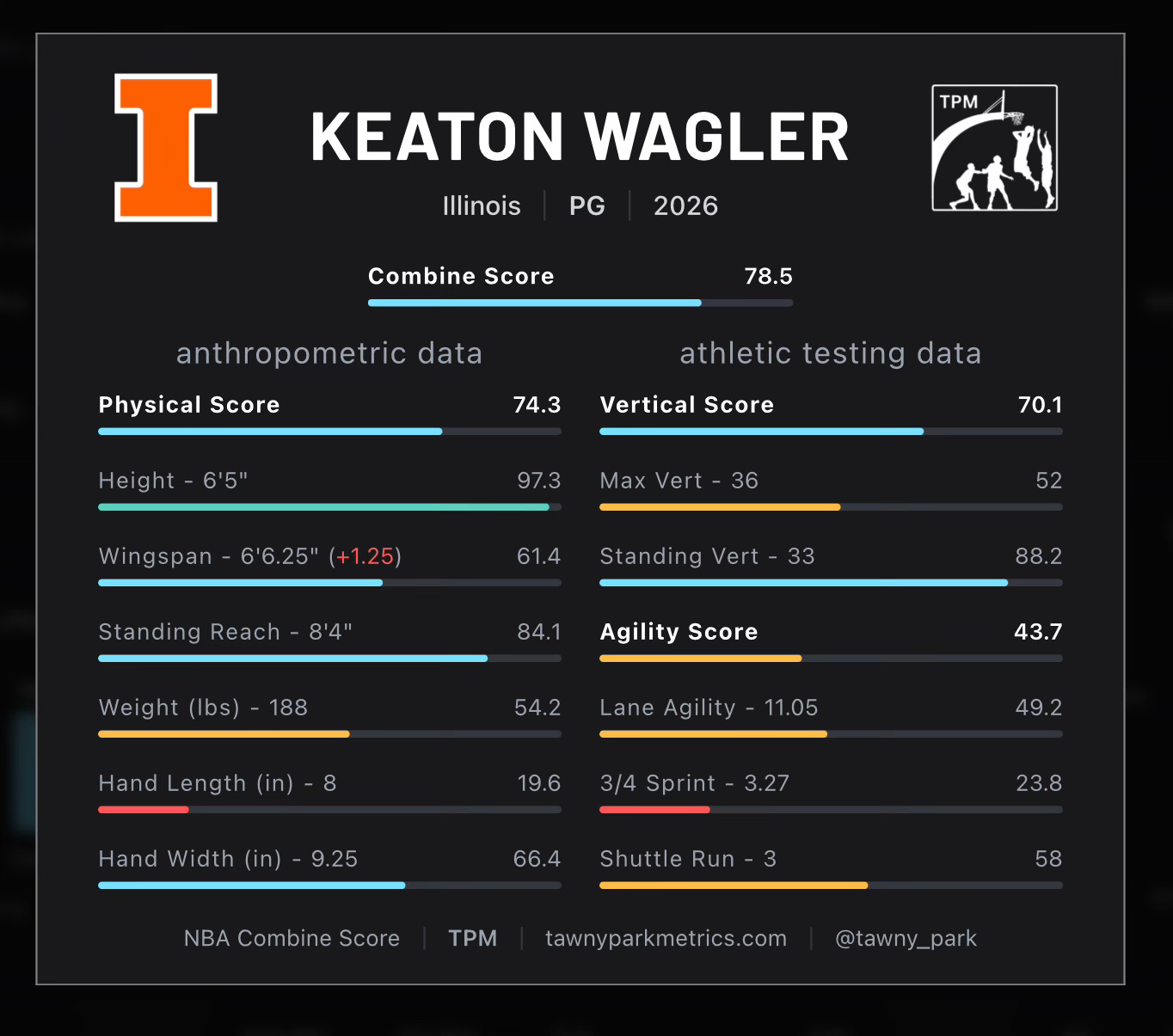
Graph Via: TawnyPark Metrics
The real questions about Wagler’s physical profile lie within his athletic testing. For me personally, I don’t care in the slightest if someone is considered a “poor athlete” by NBA standards as long as that player can still produce. One of the biggest misunderstandings in the scouting community is that athleticism is necessary to make an impact, particularly regarding defensive malleability and rim pressure — a statement that is inherently false. There have been countless “poor athletes” who went on to have amazing NBA careers in a wide variety of roles, and I believe Wagler is next in that line. Is it helpful to be an elite athlete? Sure, but it is by no means a requirement. In Wagler’s case, I even find myself thinking that his athletic concerns have been blown out of proportion. At the combine, he tested with a 36-inch max vertical, a 3.0-second shuttle run and an 11.05-second lane agility. None of those marks are elite by any means, but all of them tested around average for a point guard, which is impressive considering his plus size. Now, I will admit that these average athletic numbers don’t necessarily pop on tape, but at worst, it’s encouraging to know that he isn’t too far behind the NBA pack.
Season of Ups:
As I mentioned in the intro, Wagler did have a teeny bit of buzz surrounding his name entering his freshman season. That buzz was only amplified after the Illini announced he was entering the year in the starting lineup, but things didn’t get off to the most ideal start. Through Illinois’ first eight games, they played a fair mix of solid Power Four-level talent, along with the typical tune-up of low-major schools. Throughout those first eight games, Wagler flashed his potential, averaging 13.5 points, 5.3 rebounds and 2.0 assists per game. However, his production saw a noticeable decline when matched up against the aforementioned Power Four competition. Against Texas Tech he had just 11 points and 0 assists on 3-of-9 shooting. Against Alabama it was just 8 points on 2-of-9 shooting. Against UConn it was just 3 points, as Wagler only saw 14 minutes of action for schematic reasons. After that UConn game, it seemed as if the draft hype around him had stalled, as it was clear he was talented, but not yet capable of handling NBA-level athletes and physicality. It was after that UConn game that everything changed.
From that day on, Wagler never once dipped below 10 points and truly came into his own. His real coming-out party was a game I got to witness live, as the Illinois matchup against Missouri at the Enterprise Center was a true eye-opener. Wagler was fluid, confident, aggressive and assertive throughout the entire game, but I was even more impressed with what he did outside of the 40 minutes. As someone who was given floor access pregame, I was given the chance to get to the arena a couple hours before the game and right when I arrived I checked the court to see one man, and one man only, working on his craft. That man was, as I’m sure you can guess, Wagler, and it was what he was doing that really caught my eye. It was game reps. All Wagler was doing for the entirety of his warmup was working on actions that would benefit him in the game. Sprinting to spots, attacking, kicking out, relocating, working on pick-and-roll passing, movement shooting — it was all there. Because of this, it came as no surprise to me that he did what he did in the game, finishing with 22 points, 8 rebounds, 4 assists, 2 steals and 2 blocks. In the postgame interviews he was just as mature as his game too, giving humble yet confident answers. After that game I left thinking that Wagler was a lottery lock, assuming that it was the highest I’d ever get on him. But then came the Kylan Boswell injury, which forced Brad Underwood to put the ball into the hands of the true freshman, trusting him as his lead and primary creator. Most players in Wagler’s spot would have struggled or, at worst, gone through some growing pains. To that I say he isn’t most players, because my God did Wagler level up.
Over that stretch of games he posted averages of 26.5 points, 4.0 rebounds and 5.3 assists a game, doing so whilst shooting 53.7% from three and getting to the line nearly 10 times a game. Video game numbers. Over this stretch, Wagler had multiple marquee performances, including a 46-point game in a win at Mackey, 23 in the second half in a win over Nebraska and a 34-point outing in an overtime loss to Wisconsin. He did have some slip-ups following this stretch, as Boswell’s return threw a bit of a wrench into the momentum he had built. However, unsurprisingly, Wagler and the rest of the Fighting Illini found their groove once again come tournament time, storming their way to a Final Four appearance. In the tournament, Wagler was without a doubt Illinois’ best player, averaging 18.0 points, 6.8 rebounds, 3.4 assists and 1.6 stocks a game. His offensive numbers may not have been as eye-popping as they were at times in the past, but Wagler showed even more layers to his game than previously, upping his defensive intensity and falling into whatever mold Underwood needed him in. Illinois did, of course, fall short in the end, but the run to the big dance was nothing short of special and perfectly encapsulated what was an amazing season from the stellar freshman.
Defense:
Typically I start player profiles by outlining a guy’s offensive skillset and what makes him stand out on that end. In Wagler’s case, a lot of people are probably confused as to why I’m not starting there, as it is without a doubt his money-maker. However, I chose to start this breakdown with the defensive side of the ball solely because I have a lot to get off my chest about his defensive tape. Let’s get the big stuff out of the way first: I don’t think Wagler is a bad defender. I understand that he was not perfect last year and has a lot to improve upon, all of which I will get to. However, I feel as if people took his poor stock rates as the gospel that preaches for his entire defensive repertoire, and that is something I can’t get behind.
Video via: No Ceilings NBA
The way I see it, Wagler projects as a solid, scheme-dependent team defender who fits into the flow and doesn’t stick out. The biggest reason I believe this is his size, which gives him a great baseline to, at worst, be malleable with the positions he can guard. Another reason I think this is because he did it last year. Despite all the hoopla surrounding his name and everyone calling him an awful defender, Wagler still posted a -2.4 DRAPM and a 2.8 DBPM. Neither of those numbers are poignant enough to flip a narrative, but at worst they suggest that he has more to offer than many believe. The reason why I think Wagler was able to post that level of value is because of his approach on the defensive side of things. The best thing he does on that end of the floor is keep guys away from the basket. Wagler ranked in the 99th percentile as a rim deterrer, which is wildly impressive considering the amount of time he spent at the point of attack. Along with keeping guys away from the basket, Wagler simply makes it more difficult for them to hit shots over him. Opponents shot 0.7% worse on two-point attempts when guarded by him and 1.1% worse on three-point attempts. It also isn’t any secret as to how Wagler is able to do what he does. He is a risk-averse defender. This alone can be proven by his 1.7% steal rate, 1.3% block rate and negative stock-to-foul ratio, all of which confirm the hypothesis I just laid out. The tape backs it up too, as Wagler’s approach to the defensive side of the basketball is evidently tame. Rarely will he leap out of position to make a play on the ball or leave an assignment in hopes of creating an event. Rather, he focuses on the ball and man, remaining in the right position and staying within the flow of things. I do think that part of why he was that tame falls on Underwood and his coaching style, which is focused on speeding things up on offense and slowing opposing teams down on defense. As a result, the entire Illinois team took a more careful approach on that end, trying their best to force difficult shots on the perimeter and funnel the drives they did allow into their plethora of rim protectors. That scheme alone may not be the most glamorous or fun to watch, but it undoubtedly worked in their favor, as evidenced by their success in March.
However, the points of the year where I thought Wagler was most impressive came at the start and end of his freshman season. I already spoke on how I felt he elevated himself as a defender on the biggest stage, playing more aggressively, confidently and intensely, which resulted in a bit more production as well. At the start of the year, however, Wagler had a lesser burden on offense and was tasked with a bigger role on defense. Those games may have brought some inconsistency, particularly on the offensive end, but I thought Wagler’s defense was truly great. The Texas Tech game in particular stands out to me. Tech, of course, had quite the point guard last year in Christian Anderson, who Wagler was tasked with guarding for a fair majority of that game. Although Anderson was able to dish out 11 assists, the majority of which were to big fella JT Toppin — who I love and am hoping recovers well — he was shut off as a scorer. It was just 8 points on 33.3% shooting from the field and 0% from three that Anderson produced that day, and a large part of his struggles can be attributed to Wagler. In fact, that was likely the main reason he played 35 minutes that game despite not being his typical self on the offensive end.
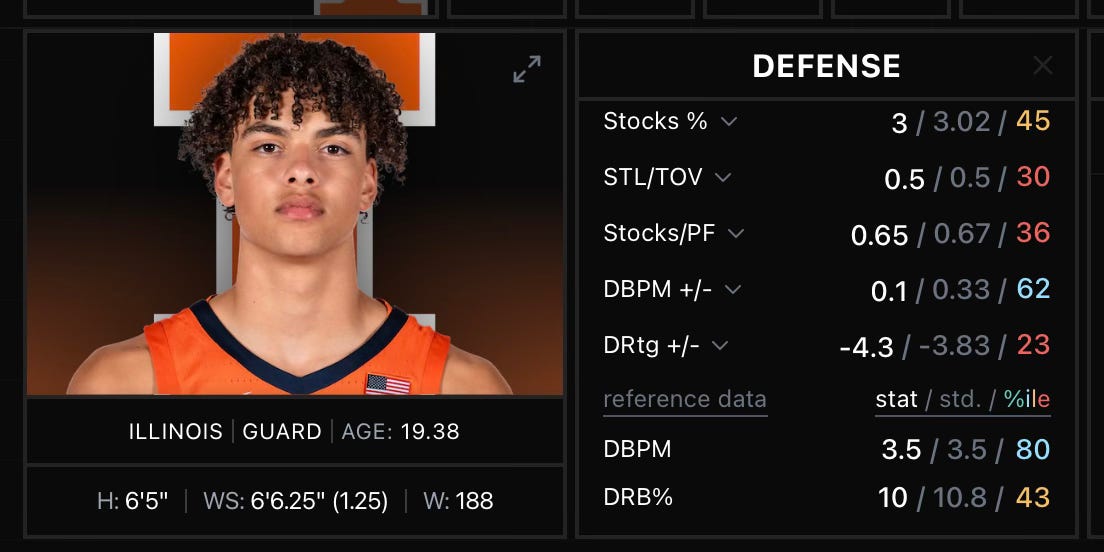
Graphic via: TawnyPark Metrics
With all this said, I am not oblivious to Wagler’s flaws as a defender, which stem well beyond just not being aggressive. The feet are obviously an issue and likely always will be. Wagler has never been and likely never will be a Davion Mitchell-type defender who can sit on opposing ball handlers’ hips for the duration of a possession and never give up an inch. As a result, he is forced to give up more space to opposing players, which allows them to create angles and put him on his heels. In order to counteract this, Wagler has to improve his understanding of how to cut off angles and use his hands. Oftentimes when he is beaten, Wagler will choose to stay glued to the hip of his opponent rather than trying to beat them to a spot. This worked well at the college level and specifically within his team’s structure, which exploited other teams’ lack of floor spacing by placing two 7-footers at the rim who could clean up what others left behind. Sadly for Wagler, unless he lands in San Antonio, he won’t have that same luxury and will have to clean up that aspect of his game. Part of how he’s going to have to go about doing that is, like I mentioned, understanding how to use his hands. Wagler isn’t going to have the footspeed to recover and cut off driving lanes like other guards with this same issue. As a result, he will have to figure out how and when to throw subtle jabs and checks into drivers’ hips to slow their momentum without getting fouled. Technically, hand-checking is illegal, but there is no doubt that players around the NBA get away with it when disguising it properly. Call it cheap, call it dirty, it doesn’t matter. It’s part of the game that players who don’t have elite physical traits are forced to utilize.
Wagler improving his frame will also do wonders for his NBA projection as a defender. As of now, he is often not rewarded even when he puts himself in good positions, as bigger, more developed players are often able to barrel right through him. Adding that extra weight, along with doing a better job of sinking into his stance, will help mask that issue and allow him to guard a larger variety of spots. That added versatility is likely going to have to be the backbone of Wagler’s career as a defender. Without it, he will be doomed to being stuck in a purgatory of not being fast enough to keep up with guards and not strong enough to battle with wings. If he adds the strength, along with cleaning up some technique, it will allow whatever team he lands with to be more creative with how they use him and allow his positional size to work in his favor. For now, his fit is iffy, but if Wagler improves on the things I mentioned, I could very well foresee him being an average to slightly above-average defender at the NBA level.
Offense:
Now that I have decluttered the mess that is Wagler’s defensive projection, I can sink in and relax as I enjoy the astonishing offensive talent that he possesses. Obviously, Wagler is not without flaws on this end, but it's hard not to love what he did last season, especially considering he seemed to keep getting better as the year went on. Wagler is incredibly nuanced as a creator and is multi-faceted in numerous aspects of his game. Whether it's the three-level scoring potential or flashes of nuanced playmaking, Wagler has serious intrigue as an All-NBA-level talent, largely sparked by who he is on this end of the floor.
Scoring:
Kicking things off on this side of the ball, what better place to start than the most valuable thing any player can do on a basketball court: score the basketball. In Wagler’s case, it’s arguably his best and most effective trait. For anyone who has watched him play, it’s clear that what makes him so special as a scorer is his outside shooting ability — which is arguably the best in the class. Last season, Wagler shot 40.6% from three on 10.6 attempts per 100 possessions, with 51.7% of those makes being self-created. He had the entire bag of tricks on display all year, showcasing amazing balance that made everything from step-backs, pull-ups and movement shooting look just as effortless as catch-and-shoot attempts. It wasn’t just college threes that he attempted and converted either, as Wagler shot 43.5% on his attempts from 25-27 feet, which is roughly the average range of an NBA three, suggesting the translation for him won’t be difficult. His shot itself is pretty too, combining a quick release with a sturdy base, all culminating in a smooth flick at the end. My only gripe with his shot is that his release is a bit out in front of him due to the nature of him having more of a push shot. However, getting his shot off with or without a contest hasn’t seemed to be an issue for him yet, so for now I will remain wildly encouraged. The midrange numbers, however, aren’t as glamorous.
Wagler shot just 34.7% on short midrange shots and 35.3% on long midrange shots, neither of which are very encouraging. However, I am personally not as pessimistic about his in-between game as most are due to the context in which most of those shots came. For one, he didn’t take many, attempting just 4.5 per 100 possessions — a mark much lower than his rim and three-point volume. On top of that, most of his midrange shots were what I would call last-ditch attempts taken as a heave of sorts toward the end of shot clocks. It was a lot of tough pull-ups, contested fadeaways and, overall, a flat-out difficult shot diet. I’m not one to speculate, but from what I gathered as an outsider, it didn’t seem as if Underwood encouraged his players to shoot midrange shots, focusing more on getting threes and rim attempts. That is a strategy that more and more college basketball teams are leaning on in the modern, analytically driven era. But I wouldn’t have minded a few more midrange pull-ups for Wagler in order to take some pressure off himself as a driver — which, as many know, is the gripe with his offensive game.
Video via: No Ceilings NBA
For me personally, I don’t find the rim-finishing issues to be as severe as others make them out to be. I understand that the raw 57.5% he shot at the rim last season is far from an elite number, but when given the full context of his shot profile at the basket, things begin to look a bit more compelling. For one, he got to the rim at a fairly high rate, especially considering his athletic limitations. Wagler generated 7.5 rim attempts per 100 possessions, 3.7 of which were self-created, putting him in the 83rd percentile of guard prospects. Once there, he obviously struggled to finish, including the now-infamous zero-dunks stat that everyone loves to throw around. However, despite struggling to finish at the rim, Wagler got to the free-throw line a lot — like, 47.6% of his shots at the rim resulting in free-throw attempts a lot. Getting to the line is a process for him, but foul drawing is a legitimate skill and a valuable one at that. Wagler is able to get himself quality looks at the basket and draw fouls not by being reckless or flopping relentlessly. Rather, he combines pace, footwork and an understanding of angles to put himself in the right spots. One of my favorite traits that Wagler has is this innate ability to use his outside shot as a weapon for his drives, seemingly teasing defenders into closing out too hard or jumping on a shot fake, which in turn creates an advantage for him as a driver. Once around that player, Wagler is great at holding his driving angles despite being so thin-framed, even using bumps and shoulder checks to create space along the way. Obviously, the finishing alone will have to improve, but luckily for Wagler, I think it’s possible. A lot of his misses came as a result of him doing too much, either by contorting in the air to hunt an absent angle or trying to get the ball to a spot he physically couldn’t reach. I think adding some floater touch will do wonders for Wagler’s finishing, as having that added refinement in the intermediate area will force rim protectors to come out and meet him farther from the basket. Because of this, more space is created for Wagler to find angles, making his life around the rim much easier. Nonetheless, even without a truly well-rounded scoring arsenal, Wagler was still able to be efficient in totality, posting a 59.6% true shooting percentage. Having that as a baseline entering the league while knowing there is still so much room to improve is exactly why I find Wagler to be one of, if not the most potent scorers in the 2026 NBA Draft.
Playmaking:
The playmaking aspect of Wagler’s game is likely going to be the separating factor between whether he can be a point guard at the next level or if he will have to resort to a more off-ball-centric role. In either case, I think he will return high-end value because that’s just the raw talent I believe him to be. However, if Wagler were to reach the All-NBA upside that I believe he has, a large part of it would likely be due to continued growth in this aspect of his game. Luckily, Wagler has already shown growth over the past year, showcasing steady development in both his ability to protect the ball and dish it out to others. I would by no means classify him as a game-breaking passer, rather a connector who is advanced in certain areas. But considering the path he is on, I have no reason to think he can’t continue to improve as time progresses.
Video via: No Ceilings NBA
The biggest thing I gathered as to why Wagler’s passing improved so much throughout the season actually had little to do with his passing. The part of his game that opened up his passing the most was actually his scoring threat, as the added defensive attention created opportunities that weren’t there prior. As the season went on, Wagler drew more defensive attention and became better equipped to counter it. But even with all that in mind, decision-making is the biggest factor in a player’s passing ability, and that’s a component of Wagler’s game that is undoubtedly ahead of the curve. For one, he’s extremely turnover-averse. Despite handling a 25.7% usage rate, Wagler posted just a 12.5% turnover rate and a 2.4 assist-to-turnover ratio. Even though he’s thin and isn’t the most natural point guard, Wagler didn’t get bullied. He was able to absorb the bumps and physicality that opposing defenses threw his way. Impressive stuff for a freshman if you ask me.
Beyond just protecting the ball, Wagler was also advanced as a passer, especially in manufactured situations. In transition and ball-screen situations is where he was at his best, using the space he had completely to his advantage. Ball-screen sets in particular are where I loved his passing, as he seemed to always make the right decision. Of course, Wagler had the benefit of almost everyone he shared the floor with being a respectable outside shooter, a luxury most other guards in the country don’t have. However, being able to dissect a well-spaced floor is a great trait to have, and it’s one that Wagler absolutely possesses. Everything from lobs to dump-offs was easy work for him, toying with the defenders in front of him en route to the basket. He also does an amazing job of stopping his momentum and playing off two feet, giving himself time to both survey the floor and create passing angles. Wagler has elite anticipation as a drive-and-kick passer as well, reading where defenses are going and making the pass he deems fit.
Live-dribble passing is an area that I would like to see him improve in, however, as lacking it does limit him in some ways. For one, it negates some of the advantages his size provides, as not being able to quickly whip passes over defenders’ heads limits the edge he inherently has. However, Wagler did show some progression in this department, particularly when hitting the pop man. It wasn’t all the time, but Wagler seemed to build some chemistry with his big men as the season went on, improving the timing of when they wanted the ball on the perimeter. Obviously, a lot of that feel will have to be rebuilt at the next level with a new system and teammates, but nonetheless, the history of development is there.
NBA Projection:
If for whatever reason you couldn’t tell by now, I’ll once again say it loud and proud: I am a HUGE fan of Keaton Wagler. As I mentioned earlier, he currently finds himself firmly in the top four on my board, and I think he has a really good chance of finishing in the top three. It’s rare to find prospects who can couple rapid development with plus positional size and a well-rounded skill set, all at the ripe age of 19. Not to mention, a lot of his flaws are very fixable. Things like adding weight, cleaning up technique and moving his shot touch inward — which is odd because it’s typically the other way around — will all benefit him immensely at the next level.
There is a good chance that Wagler struggles early on, as I can definitely foresee a world where the physical and athletic leap to the NBA proves overwhelming. However, he has enough skills between his playmaking, shooting and rebounding — something I didn’t even mention that he excels at — that I just can’t foresee a world where he doesn’t carve out a role early on that expands as he gets more accustomed to the NBA level. Even if it is a more off-ball centric role where he is shrunk into the box of three and D in his early days, I still think he will find ways to make an impact. Wagler likely will hit a rookie wall or sophomore slump too, as once defenses figure him out, he will be forced to adjust. However, given his track record, I have no reason to believe that he won’t do just that. In short, he is a high-floor, high-ceiling prospect who screams NBA star when I watch him. It may be a risk to some, but if I were the Clippers at five — hell, even the Bulls at four — I would be jumping all over the opportunity to bring Wagler into my program and build for the future. The future’s guard and one of my favorite prospects I’ve ever gotten to evaluate: Keaton fricking Wagler.