

Morez Johnson Scouting Deepdive
Michigan's Morez Johnson Jr, perhaps the most physically imposing player in this year's draft class, offers an easily translatable game and an underrated long-term outlook
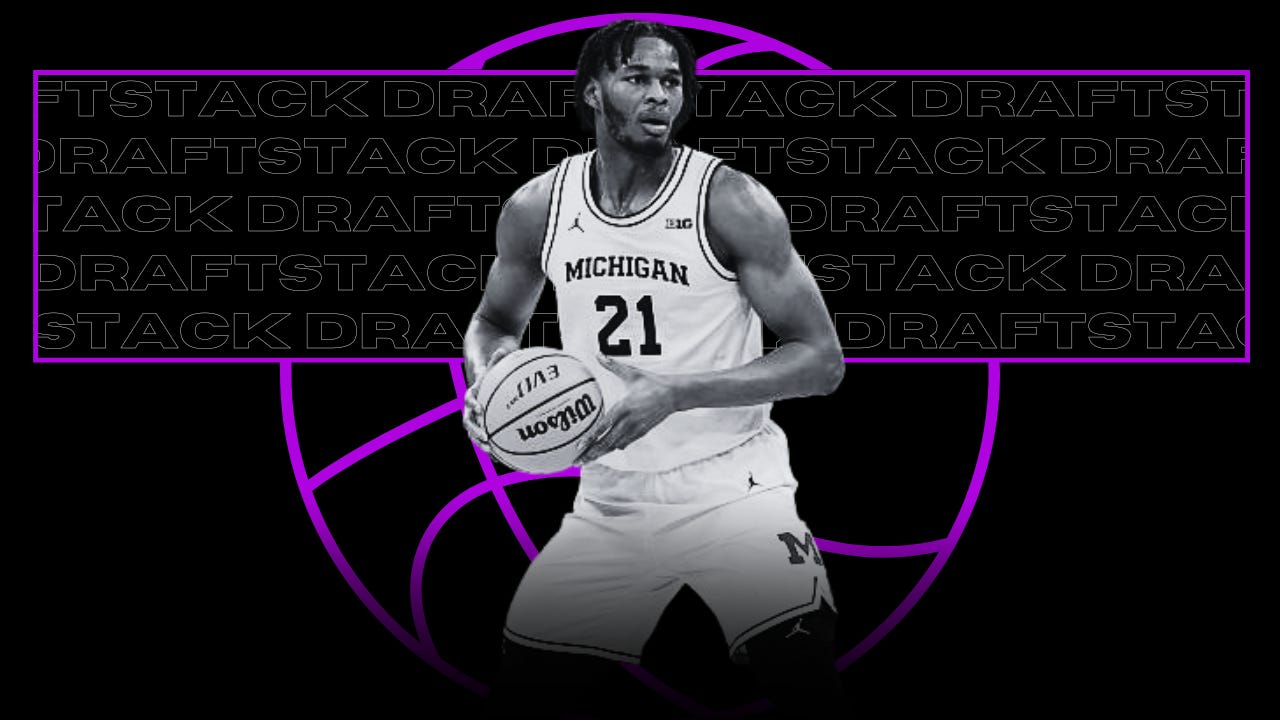
It could be argued that no player in the country took a bigger leap this season than Michigan’s Morez Johnson Jr, who spent his freshman season playing an off-the-bench sparkplug role for an average Illinois team. He hit the transfer portal soon after his freshman year came to an end, and following a strong showing in last summer’s FIBA U19 World Cup, he debuted with a Wolverines squad that would eventually dominate on their way to a national championship. Now, the former backup will likely be selected in the upcoming NBA Draft’s lottery alongside two of his Michigan frontcourt-mates, as his sophomore campaign not only proved that he’s a fantastic college contributor, but also a highly coveted professional prospect. Today, I want to break down Johnson’s game in its entirety, analyzing every individual element of his skillset while considering his strengths, weaknesses, ceiling, and floor. With all of that being said, let’s jump into it.
Player Profile:
Morez Johnson Jr is a 6’10” and 250lb power forward from Riverdale, Illinois who played the first three years of his high school career with St. Rita of Cascia High School before transferring to Thornton Township High School for his senior campaign. As a junior with St. Rita, he was named an Illinois first-team all-state selectee, alongside notable names such as Jeremy Fears Jr, Cam Christie, Dai Dai Ames, and Owen Freeman. As a senior with Thornton Township, he posted averages of 17.2 points per game, 14.1 rebounds, 3.5 assists, 3.4 blocks, and 2.5 steals on shooting splits of 50% from the field, 34% from beyond the arc, and 66% from the free-throw line. These averages, along with a 29-5 record, were good enough for Johnson to be named Illinois Mr. Basketball following his senior season.
By the end of his high school career, Johnson was a consensus four-star and top 30 recruit in the class of 2024. However, he committed to Illinois, his home state program, before the beginning of his sophomore season. He chose the Fighting Illini over Florida, Texas, Ohio State, Providence, Nebraska, and Iowa, among others. Despite being the second highest-ranked recruit in Illinois’ 2024 class, he spent most of his freshman season coming off the bench, starting only seven games (to be fair, the top-ranked recruit, Will Riley, only started nine games). In his 17.7 minutes per game, he averaged 7 points, 6.7 rebounds, .3 assists, 1.1 blocks, and .4 steals on splits of 64.2% from the field and 61.8% from the charity stripe (he did not attempt a three). Despite a promising start to his college career, he entered the transfer portal after season’s end, eventually committing to Michigan and head coach Dusty May.
In-between his freshman and sophomore seasons, he’d suit up for the United States as they travelled to Switzerland for the 2025 FIBA U19 World Cup, starting six of the team’s seven games at that event. There, he averaged 9.4 points per game, 6.4 rebounds, .6 assists, 1.7 blocks, and 1 steal on splits of 58.5% from the field and 78.3% from the free-throw line (as well as going 0/1 from three). He then landed in Ann Arbor, where he’d earn a starting spot for one of the best rosters in the country. Across forty games, in which he played 25.1 minutes per contest, he’d average 13.1 points per game, 7.3 rebounds, .3 assists, 1.1 blocks, and .7 steals on shooting splits of 62.3% from the field, 34.3% from beyond the arc, and 78.2% from the free-throw line. He made an immense two-way impact for the Wolverines, who would eventually hoist the national championship trophy to end their season.
Interior Scoring:
At-the-rim scoring is by far Johnson’s strongest scoring level, as his 72.9% conversion rate on rim attempts is an elite mark for a non-center (or any player, really). Not only is he efficient from close-range, but he’s also versatile, able to score from this level in a myriad of ways. Because of his size, strength, and athleticism, he’s a naturally proficient play finisher and off-ball operative, but he also flashed some self-creation ability this past season. Simply because his interior scoring is already so developed, I wouldn’t say that I’m overly intrigued by his long-term projection in this area, but I am confident that he’ll be able to immediately utilize these skills to impact winning for whatever organization he suits up for next season.
As far as immediate translation is concerned, Johnson’s strongest at-the-rim scoring trait will be his play finishing. For a forward, he’s an incredibly active off-ball mover, constantly setting screens, crashing the glass, and applying pressure to the rim. When he picks up momentum coming downhill, there’s really nothing a defender can do to stop him, as he’s a massive individual with legitimate vertical leaping ability. That said, he usually doesn’t dunk over opponents (mostly because they usually get out of the way), instead opting to use strong mid-air body control to avoid interior defenders before throwing down emphatic dunks. Not only that, but he’s also a strong under- and around-the-rim finisher, showcasing strong spatial awareness and good touch while finishing on both sides of the rim.
He’s also an excellent lob finisher, a skill that proved to be important for a Michigan team that fielded multiple strong lob passers. His ability to not only catch lobs for dunks but also bring them down before going back up for easy layups allows his teammates to throw him lobs under more circumstances. He’s great at sealing off his defender before elevating vertically to receive the pass, and his hands are fantastic. I don’t know if his lob diet will be this diverse once he reaches the league, but it’s an interesting wrinkle for an already very effective part of his game.
While Johnson is certainly more efficient as an off-ball operative, he’s also a very strong self-creator when he receives the ball in the post. Because of his incredible strength, he was able to back down anyone he matched up against this past season, and once he finds good court position under the rim, he’s almost always going to finish the layup. He’s also capable of facing up his defender, putting the ball on the floor, and finishing the layup no matter the angle of the attempt. His only flaws here are that he’ll occasionally turn the ball over if he dribbles it more than two or three times, and he forces the issue too often once double- and triple-teams meet him at the rim. He did show some dribble-drive flashes, but I don’t expect that to be a major part of his inside scoring game anytime soon.
There’s a strange type of interior attempt that makes up a decent chunk of Johnson’s shot diet from this level, and I’ve labeled them “brute force” layups. They fall somewhere in-between self-created and off-ball attempts, as most of the time they follow a pass and no dribbles, but he does take a single dribble here and there. On these attempts, he powers through one or more defenders, absorbs a ton of contact, and often draws a foul in the process. He also shows off his elite balance and poise here, as he’s able to land, immediately get harassed by multiple defenders, and still finish the layup. These weren’t part of Michigan’s game plan, and are more so found via impromptu opportunities, but I think he’ll continue to do this in the future.
Mid-Range Scoring:
As of today, Johnson isn’t a very good mid-range scorer, but he has grown from this level, and I expect him to continue developing his mid-range game moving forward. He only attempts 2.8 mid-range shots every 100 possessions, and made only 35.8% of those shots this year, but that’s almost double the volume from his freshman season. I’d be shocked if he ever develops a super strong traditional mid-range game (even though he did try his hand at these attempts this year), but I do think he could incorporate more push shots, hook shots, and floaters into his game as he progresses through his career.
I do find it strange that push shots aren’t already a bigger part of his game, but I guess when you’re able to get at-the-rim attempts at-will, you’ll take those instead. He does seem to have legitimate touch, something that was made even more apparent this year as he took a step up in three-point and free-throw shooting. By strengthening this element of his game and increasing his volume in the process, he’ll be able to better attack bigger NBA defenses who may be able to occasionally match his strength. This never has to be something he falls back on, especially if he continues to get better as an outside shooter, but it would help diversify his game in a very positive way.
As I mentioned, Johnson did try his hand at attempting traditional mid-range jumpers this season, but this was a rarity. I don’t expect this to be a part of his game anytime soon. However, he barely attempted these shots, and they didn’t look too shabby when he threw them up. Because he so easily dislodges defenders on his post-ups, he’s actually able to create quite a bit of space for turnaround jumpers. That said, his poor percentage from this level indicates that he has quite a bit of work to do before he’ll possess the comfort, confidence, and overall feel necessary to rely on this scoring level, but the foundation is intriguing to say the least.
Outside Shooting:
For a guy who didn’t attempt a single three during his freshman season and only one in the FIBA U19 World Cup, he really doesn’t look too far away from being a decent outside shooter. He did shoot 34% from long-range during his senior year of high school, and that was on 1.5 attempts per game, so this development wasn’t totally unexpected. He only attempted .9 attempts per game this year, equating to 1.9 attempts per 100 possessions, but that’s a far greater number than many expected to see from him coming into the year. In my opinion, his mechanics look smooth enough for him to eventually develop into a competent option from long-range.
Obviously, Johnson’s threes come off-the-catch, but I was surprised to see that they usually didn’t come on pick-and-pop possessions. Most of the time, he saw open threes on kickout or swing passes when his defender dropped in to help defend the paint. Opponents were willing to leave him open from the perimeter, especially earlier in the season, but by season’s end he had proven capable of knocking down these attempts. He does seem to have a small hitch in his shot motion, but it’s nothing too dramatic. With practice and repetition, he could very well turn into a solid three-point shooter, forcing defenders to meet him on the perimeter, opening up the floor for his teammates and allowing him to more frequently try his hand at getting downhill.
Passing & Playmaking:
Because he found himself double-teamed in the post incredibly often, Johnson was able to take a step up as a passer and all-around decision maker during his sophomore season. This is another area where he proved capable during his dominant senior season at Thornton Township, but an area that very few expected much from after a freshman season where he was, at most, a tertiary ball mover. This isn’t to say that he was a dominant pass-first offensive hub this season; he averaged only 1.2 assists per game, but his ability to utilize his passing game to get out of sticky situations while making the game easier for his teammates will surely translate to the league.
In addition to low post kickouts, which made up a large portion of his assist total, he also found open teammates following offensive rebounds, of which he grabbed a ton (more on that later). Rebounds are an excellent playmaking opportunity, as opposing defenses tend to be in a scramble, leading to open teammates from beyond the arc and inside. Assuming that he’ll maintain his dominant rebounding in the league, one could then assume that he’ll continue to showcase his passing in the same way. The one issue I saw from him in this department is his tendency to throw the ball either over his teammate or high to the point where they can’t take an in-rhythm jumper. Perhaps he’s simply too strong for his own good, but he’ll have to improve his accuracy, as NBA defenders are excellent at closing out to shooters.
Mostly because he rarely handles the ball on the perimeter, he doesn’t usually find teammates on the interior. However, much in the same way that offensive rebounds often lead to easy passes out to open shooters; he was also able to find cutting teammates for open looks at the rim. This was far less common, but in these limited instances we get to see his quick decision making at work, and I think he looks far more comfortable in these situations than most of his frontcourt contemporaries. It’s worth noting that he does have a negative assist-to-turnover ratio (1.2:1.3), but that’s not uncommon for players who aren’t regularly asked to play make for others. Also, 1.3 turnovers is nothing to worry about, especially for a player who sees help defenders as often as Johnson does.
Defense & Rebounding:
While Johnson does have a very effective and translatable offensive game, one could argue that his value primarily lies in his defensive impact, as he’s one of the better all-around defenders in this year’s draft class. His 4.4 DBPM is one of the best marks in the class, with the players ahead of him either being a few years older, blue-chip freshmen, or defense-first players. Among sophomores and freshmen in this class, he ranks fifth in that all-encompassing stat. That said, he does a few things better than many of those players, especially as a rebounder, and I expect his impact on this end of the floor to be felt immediately once he steps foot on an NBA court.
Johnson isn’t a primary rim protector, but he’s an explosive secondary help option who flies around the floor, both in the half and open court, for emphatic swats. He’s not only a defensive playmaker; he’s a defensive event creator, a true momentum swinger who can sap an opponent of his confidence by sending his shot into the stands. It makes it even more impressive that he usually does this on the run, perfectly timing his steps and his leap to end up at the right place at the right time. His 4.8% block percentage is impressive, and I expect his rim protection numbers to remain mostly the same moving forward seeing that he spent his sophomore season playing alongside an NBA-caliber primary rim protector in Aday Mara.
What makes Johnson a truly special defender is his ability to switch onto multiple positions (at least at the college level) and hold his own. This doesn’t usually result in blocks, but it’ll occur on occasion when a smaller player (or Robbie Avila) tries to attempt a pull-up jumper after he switches onto them. He’s an excellent lateral mover capable of covering enough ground to keep up with much quicker opponents, and I see no reason why this wouldn’t continue to be the case in the league. Sure, he may not be able to defend NBA point guards, but I like his odds against wings, forwards, and centers.
Something that he doesn’t do particularly well is generate steals, despite his ability to match up against most opponents. He’s very conservative when it comes to this aspect of the game, rarely attempting to leap passing lanes or poke balls loose. Instead, he allows his matchup to receive the ball, as he likes his odds of defending them the good ole’ fashioned way. I like how confident he is in his abilities. That said, he’ll still grab a steal from time-to-time, as he does have fast hands and strong defensive instincts. I’m curious to see if he becomes a more eager defensive playmaker as his career progresses and opponents begin to catch up to him from an athletic perspective.
The moment you all have been waiting for: discussion regarding what I think is Johnson’s strongest trait. This is a guy who, as a 6’10” sophomore, was the best rebounder on a team that featured 7’4” Aday Mara and 6’10” elite rebounder Yaxel Lendeborg. His 7.3 rebounds don’t tell the whole story, as he was sharing the court with those two. I honestly think that, had he been the lone elite rebounder on his team, he could have led the country in rebounds this season. He’s great in this aspect of the game for all the reasons we’ve already discussed, such as his size, strength, and athleticism, but he also has an incredible motor and second-to-none timing. He boasted a staggering 12.8% offensive rebounding percentage this season; another stat that doesn’t truly illustrate how dominant he is on the glass because of how stacked his team was.
Not only is he great at gobbling up rebounds, but he’s also great at turning those boards into points for either himself or his teammates. He consistently throws down putback dunks, has a strong feel for tip-ins and non-dunk putbacks, and is able to absorb a ton of contact. As we already mentioned, he’s also an effective passer following an offensive board. All in all, his rebounding alone could get him drafted into the NBA, a reality that makes Johnson all the more enticing for front offices when you consider all of the other things he brings to the table.
Summary:
Before I summarize Johnson’s game, I want to list out any and all of his weaknesses and flaws in order to garner a better understanding of his game in its entirety. Because he does have a rather simple and translatable game, he doesn’t have as many glaring weaknesses as many of his peers. That said, his game also leaves things to be desired from a long-term perspective. What’s most important when it comes to his development is that he views his flaws as areas in need of improvement rather than areas void of potential. Players who do this are often those that eventually rise to the top of the sport.
Johnson’s ball security in the post when he puts the ball on the floor more than two or three times isn’t the greatest. He sets his sight on the rim, allowing help defenders to poke balls loose. Unless he improves as an overall scorer, he doesn’t need to have the ball in his hands down low for extended periods of time.
He’s not much of a creator from the perimeter, as he doesn’t have the handle necessary to consistently put together effective downhill drives. Again, until he improves, he probably doesn’t need to put the ball on the floor too much.
He can sometimes get sped up as a play finisher, putting too much power on his non-dunk at-the-rim attempts when he gets a head full of steam. I think it would serve him well if he got used to coming to a stop and working off two feet on certain play finishing opportunities.
Despite showing flashes throughout his sophomore season, he needs to quickly improve as a mid-range operative if he wants that to be a prominent part of his game in the future. His touch shot game is more impressive than his traditional jumpers are, and he should prioritize his development from this range in that order.
While his outside shooting improved drastically this season, I still don’t consider him to be a true three-point shooting prospect, and I’m fairly confident that front offices would agree with me. He needs to fix his slight hitch, increase his volume, and improve his percentage before he’ll be tasked with outside shooting in the league.
The only glaring flaw that I noticed when studying his passing game is that his kickout passes aren’t very accurate. This was noted in the passing and playmaking section. He often throws the ball far too high on his kickout passes, forcing teammates into tough shots.
He could afford to be a more aggressive defender and more willing to look for steals. This would be less risky for him than it is for many others considering how good of a recovery rim protector he is. This is the only truly strange aspect of his defensive game.
To summarize Morez Johnson Jr’s game, I’d argue that he’s one of the easier to place players in his draft class. His game is incredibly effective; he was one of the most impactful players in the country this season, but he’s most intriguing because he was able to make that impact without being his team’s first, second, or third scoring option. Sure, he averaged more points than Elliot Cadeau, but the offense was never run through Johnson the way it was run through Lendeborg, Mara, and Cadeau. He was able to make this impact via easily replicated interior offense, all-around versatile defense, and elite glass cleaning. This was made possible because of his strength, size, athleticism, and elite work ethic, traits that will immediately translate to the league.
With that said, what makes Johnson even more intriguing is his burgeoning offensive game. Following a freshman season with Illinois where he wasn’t allowed to stretch his game outside of the paint, he dabbled with mid-range and beyond the arc shot making this year. He was also given the opportunity to showcase his passing and decision-making abilities. Most evaluators aren’t looking at him as a high ceiling player simply because of how simple his game is currently, but there’s no reason to think that a sophomore who has already shown us as much as Johnson has wouldn’t have a lofty ceiling. For these reasons, he’ll make whatever organization that drafts him very happy as soon as he throws on their jersey, but if they’re good enough at their jobs to turn him into the player he projects to be, we could be looking at one of the NBA’s best long-term frontcourt prospects.