

Nate Ament Scouting Report
Putting Nate Ament, one of the 2026 Draft's most confusing prospects on trial to get to the bottom of his evaluation
Opening Statements:
What if I told you that a former top-five recruit in the nation who is a near 7-foot-tall forward, averaged 16.7 points, 6.3 rebounds and 2.3 assists per game in his freshman year, can “shoot” the three ball and provide positional versatility on defense doesn’t even have a top-20 grade on my board? If that statement seems outlandish to you, then I ask you to brace yourself as I introduce the topic of today’s discussion: the king of controversy himself and the most divisive prospect I’ve ever evaluated, Nate Ament. Coming into this year, there was a real crowd — including myself — that believed Ament had a chance to compete for a top-three slot in this year’s draft. His high school tape was by no means perfect, but the flashes of high-level shot creation and positional versatility were absolutely enough to warrant top-of-the-draft buzz. However, the ensuing year was nothing short of a disheveled jumble of highs and lows that leaves me completely lost as to what to think about the 19-year-old.
On one hand, the production isn’t bad — even when considering the nuance that leaves him where he’s at. But on the other hand, Ament played stretches of basketball where he didn’t even look like a solid college player, let alone a lottery talent in the draft. I say all this to drive home the point that everyone wants to understand Ament. His skillset is polarizing and, if he reaches his highest-end outcome, he could be a transcendent talent. However, the idea that you can just pencil in someone as inconsistent as him in the top 10 solely based on the idea of him reaching his top 1% outcome is fundamentally flawed. Who Ament will actually end up being is a case worth solving, and with that, I open the doors for evidence both for and against Ament the player.
Evidence For:
- Exhibit A — Physical Tools
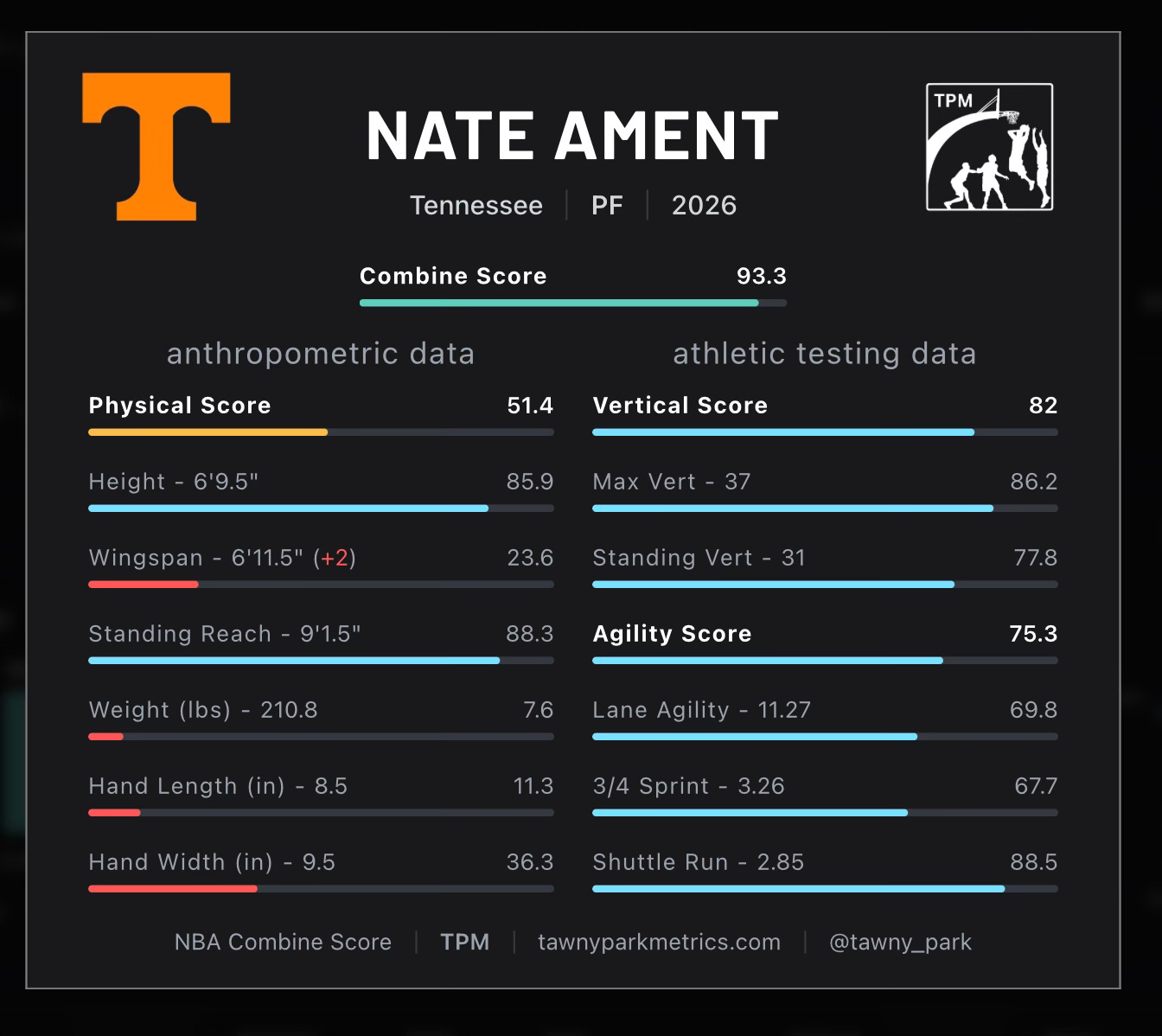
I’m starting to get to a point where I believe the entire basis for Ament’s evaluation revolves around the things that he does for a player his size. I’ll admit, 6-foot-9 and a half barefoot guys with a 6-foot-11 and a half wingspan who have ball skills tend to get fed opportunities even if they aren’t producing, solely off of the “upside” that they bring. This is even more so the case when said player leaps 37 inches off the ground, can complete a lane agility drill in 11.27 seconds and can finish a shuttle run in 3.26 seconds. If you couldn’t tell by now, the player I am describing is Mr. Ament himself, as he without a doubt fits the billing of the prototypical modern forward with high-end movement skills. However, combine testing and in-game athleticism are two vastly different things, and in Ament’s case I’m just flat-out not sold.
Graphic via: TawnyPark Matrics
Ament has great balance and is very coordinated, giving him really fluid movement patterns, which in turn can create the illusion of a great athlete. However, when actually analyzing his game and dissecting how he utilizes his athletic gifts, I was left far less optimistic. Rarely does Ament flat out blow past a guy with raw short-area quickness or fly around the court defensively, cutting off multiple drives and causing chaos. One could make the very reasonable argument that Ament has not fully grown into his body and figured out how to utilize his tools yet, and as an optimist, I tend to agree with that crowd. However, it’s never a guarantee that a player can piece everything together in the blink of an eye, as it often takes the right coaching staff and situation to truly maximize their gifts. There’s always a chance Ament could find that environment, but for now his athletic gifts are just that — athletic gifts — not tangible tools.
- Exhibit B — Skill Flashes
A reasonable argument can very well be made that Ament’s physical gifts are just a gimmick, not replicated into his actual skillset. However, what isn’t a gimmick is the truly impressive offensive flashes he has showcased over the past couple years of his basketball career. I don’t care what the context is, handling a 27.8% usage rate as a primarily off-ball-centric player on a really good basketball team is not something that you see every day, and that’s exactly what Ament did. Not to mention, he was by all accounts a positive impact player while doing so, posting a 5.1 OBPM and +3.1 ORAPM, both of which suggest true high-level impact. As I’m sure you know, one cannot just happen into production at that level, and neither did Ament despite his apparent flaws. I previously mentioned how impressive of a mover Ament is despite not being the best athlete, and that is evident in his offensive game. He displays consistently great movement patterns and balance, particularly when attacking downhill, allowing him to work his way to his spots. Heavy on the word work, but I’ll get to that later on. When working downhill, Ament clearly isn’t afraid of contact, sometimes even to his own demise, finding any way possible to work into his opponents in order to generate space. This was a skill that Ament wasn’t capable of just a year prior, but after putting on close to 20 pounds of muscle, he is now able to seek out and play through contact, resulting in him posting a remarkable 57.8% free throw rate, which landed him at the line more than seven times per game. I’ll once again reiterate that contact is the name of the game for Ament, something he was forced to embrace when restricted to confined spaces. As for his ability to actually finish at the rim, well, that’s a conversation for the latter half of the piece.
Video via: No Ceilings NBA
Beyond who he is as a rim finisher, Ament also has a very nuanced and relatively balanced shot diet. He is more than willing to shoot from all three levels, both off the dribble and off the catch, with his height allowing him to rise over almost every defender in order to get his shot off. Ament got to these spots in a variety of ways as well, handling virtually any action that Rick Barnes and Tennessee threw his way. He handled post-ups, wing isolations, pick-and-rolls both as the ball handler and roll man, along with a variety of other actions. As a result, he was given a fair amount of creative freedom regarding what spots he wanted to get to and how he got there, leading to the aforementioned balanced shot diet. Ament did have a tendency to settle in the midrange at times. In fact, almost 43% of all his shots came from there — a fair bit more than the roughly 29% that came at the rim and 32% that came from beyond the arc — but nonetheless, he was comfortable from every spot on the floor. To some, the heavy midrange diet may seem concerning, especially as it increasingly becomes a dying breed in the modern, more analytically driven NBA. However, most, if not all, elite scorers — and even the vast majority of solid scorers at the NBA level — fall back on the midrange shot, using it as a way to keep defenders honest and out of predictable schemes. With that said, I do hope that the 9.6 midrange attempts per 100 possessions can be distributed more evenly toward rim and three-point attempts, as no matter how much I advocate for the shot, it is less efficient than its counterparts. Still, keeping the midrange shot as a tool will prove valuable if he can make better use of the volume and improve in the other areas of scoring.
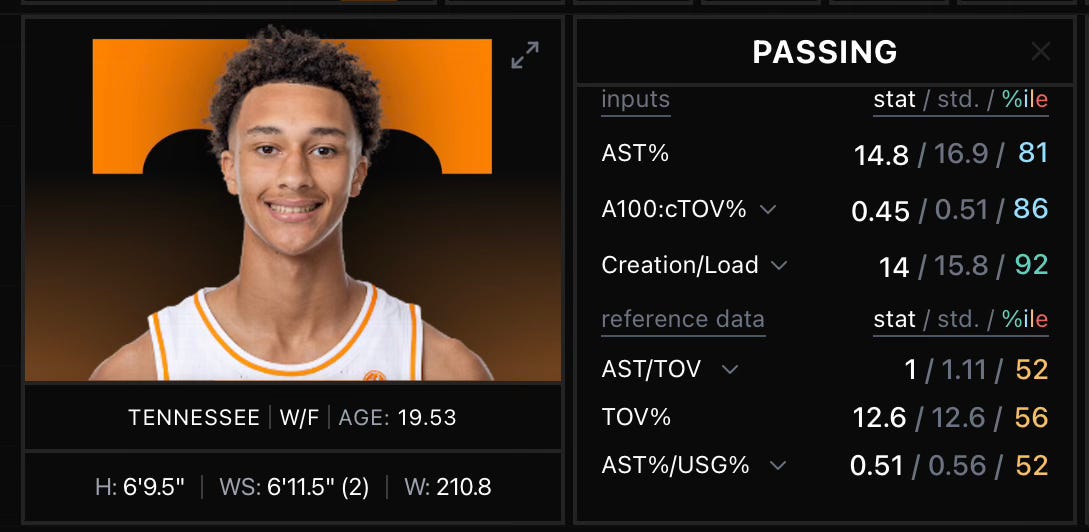
As for his passing, much like his scoring arsenal, Ament showed enough flashes to warrant intrigue. At face value, his 1:1 assist-to-turnover ratio and 14.8% assist rate aren’t exactly the sexiest numbers in the world, and I’m not going to sit here and argue that Ament is some game-breaking passer. However, for a player who handled the defensive attention that he did while carrying the usage that he did, recording just a 12.6% turnover rate is without a doubt an impressive feat. Ament is almost strictly a reactive playmaker, taking advantage of windows naturally created by his gravity and passing his way out of tough spots. He did make the occasional slick pocket pass or skip pass in the pick-and-roll that tickles my mind in just the right way, but it’s important to remember the broader context of what is going on. In totality, those flashes were just that: flashes. The vast majority of the time, especially when operating out of structure, Ament is incapable of making proactive playmaking reads, which doesn’t doom his outlook, but rather limits his ceiling. Developing that aspect of his game could be the key needed to unlock his star upside, but as long as Ament can be a steady hand who makes the simple reads and doesn’t turn the ball over, he should be just fine.
Video via: No Ceilings NBA
- Exhibit C — Defensive Upside
For as much as Ament does offensively that piques my interest, I can’t help but be equally intrigued by what he brings on the defensive side of the basketball. Take that intrigue for what you will, but nonetheless, he has tools to work with. In the early days of his freshman season, I actually found myself wildly disappointed with Ament as a defender. He wasn’t a shutdown guy in high school by any means, but he was, at worst, an event creator who could guard a variety of spots at a high level. However, the adjustment to the college game seemed to take a pretty hefty toll on Ament, evident by him recording just two blocks through Tennessee’s first 14 games of the year. Much like he did offensively, though, Ament built as the year went on defensively, and by season’s end, I was back to where I was with him coming out of high school.
Ament finished the year with a solid 2.7 DBPM, encapsulating his minor yet sufficient impact. His advanced numbers weren’t as kind to him, however, as his 2.7% block rate and 1.9% steal rate definitely leave something to be desired. On top of that, Ament had a negative stock-to-foul ratio, another thing that isn’t exactly ideal for a player his size. However, as I mentioned, he did build as the year went on and clearly figured out how to better utilize his tools. Ament is able to slide his feet fairly well for a player his size, getting low in his stance and gliding to cut off driving angles. So many players with his size end up looking like baby deer learning how to walk when matched up with guards on the perimeter, but in Ament’s case, he always seemed balanced and aware of where he needed to be.
Video via: No Ceilings NBA
Big men and more developed forwards are able to exploit Ament’s thinner frame at times, working through his chest en route to their spots, but that is something I have full confidence will fade over time. Ament has already shown great contact balance, being able to absorb bumps and hold his ground, something I can only imagine will continue to improve as his frame develops. Along with that, Ament has shown aggressive defensive flashes in certain contexts, proving that he may have more defensive upside than what he has shown so far. Overall, I wouldn’t expect Ament to be a defensive stopper by any means, but in the right context and with his tools being maximized, he could very easily end up making a positive impact.
Evidence Against:
- Exhibit A — Production Concerns
One of the great realizations that every draft scout goes through is the inevitable understanding that there are more ways to quantify impact than just the basic box score. In Ament’s case, hardly any number besides his points, rebounds and assists totals is working in his favor, so it’s no surprise that on a deeper dive, things only continue to take a turn for the worse. Starting with his efficiency, which, as I’m sure you could’ve guessed based on his raw numbers, is not great — at all. Ament posted a 53.4% true shooting percentage last season and a 45.2% effective field goal percentage, placing him in just the second percentile of forward prospects. To put it simply, Ament wasn’t efficient from any level on the floor, and in totality, it hurt his team.
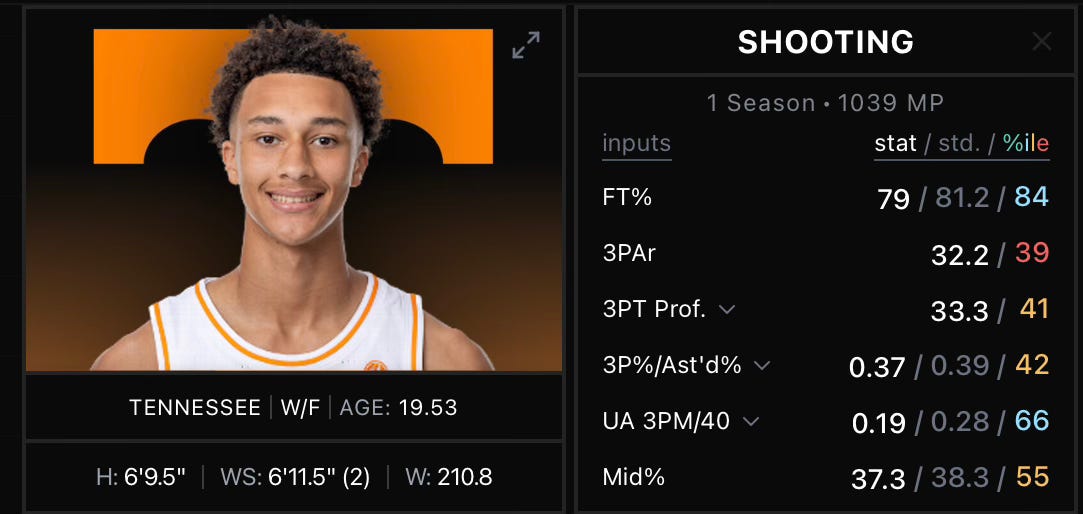
I spoke earlier about his ability to get to the free throw line and how positive of an indicator that is. However, when you stack that number against the abysmal 50.8% that he shot at the rim last season, his outlook begins to look extremely grim. This awful finishing rate isn’t just a product of poor touch or being out-athleted, either. Ament flat out doesn’t understand how to create finishing angles or how to adjust his drives to get to them. He often settles for going up straight and strong, which is beneficial when he is the superior athlete, as oftentimes defenders have no choice but to foul him. But when Ament inevitably scales up in competition and is forced to compete against players who are just as, if not more, athletic than he is, then he won’t have the same luxury. On the rare occasion that Ament does try to attack a finishing angle with a euro step, pro hop or spin move, it just looks sloppy and slow, placing him in even worse spots than where he was prior.
Graphic via: TawnyPark Matrics
However, like I mentioned, it wasn’t just rim-finishing issues that plagued his efficiency either. Ament was bad from each and every level. In the midrange, the area that he loves and relies on the most, Ament was still ineffective for reasons largely disconnected from his raw shot touch. As I mentioned earlier, Ament doesn’t have the raw athletic gifts to consistently create advantages without it being a manufactured situation. As a result, in order to get to his spots in the midrange, Ament had to work and claw and fight, taking bump after bump and redirection after redirection just to find enough space to get the ball out of his shot pocket. Because of this, his base was often off balance when he gathered, leaving him with tough shot angles and an overall bad end result. Ament shot 37.2% on short midrange shots and 33.3% on long midrange shots, which doesn’t bode well alongside his 33.3% mark from beyond the arc.
Even with how frustrating this was to watch as an evaluator, I can’t imagine it was pleasant for his teammates either, a notion that the numbers back up. In fact, despite handling such a hefty usage rate and carrying so much defensive attention, Ament was actually around a net neutral for Tennessee last year, with a fair argument that could be made for him being a net negative. His raw net rating suggests that the team was slightly better with him on the court versus off, with the raw number totaling 0.4. However, when considering the fact that the team’s offensive rating was 4.6 points worse with him on the floor and the team’s defensive rating was 4.4 points better with him off the floor, it becomes much harder to make the argument that Ament was positively contributing to winning basketball on a consistent basis. Sure, in the stretches of games where he is rolling and playing to his full potential, the team benefits from his presence, but when Ament isn’t rolling, the entire team is often negatively impacted.
This isn’t just an offensive issue either, as Ament’s defense has its fair share of flaws too. Like I mentioned earlier, he has shown a lot of positive flashes as to who he can be on the defensive side of the basketball, but for the vast majority of the year, Ament was doing more bad than good. I’ve already spoken on his horrendous defensive playmaking, especially considering his positional size, which places him in just the 25th percentile of forwards in college hoops. However, Ament’s lack of impact stems deeper than just not taking risks, as he has some real issues that opponents tend to expose.
The most glaring issue, at least in my eyes, is the method he employs on the defensive end. Ament, like many other bigger players, relies on his height a little too much, expecting that what he has in size can make up for what he lacks in foot speed and agility. However, for Ament, who is big but not quite center-big, this strategy doesn’t really work and oftentimes allows players enough space to take and make relatively open shots. Opponents may not have shot much better or worse when guarded by Ament, but one thing is certain: they were more willing to shoot when guarded by him, especially from the outside. Ament ranked in just the 11th percentile as a three-point deterrent, a mark that is very atypical for someone who isn’t patrolling the paint very often as a weakside rim protector. Much like many other aspects of his game, Ament was able to rely on his athleticism to close shooting windows against college athletes relatively quickly, but that, once again, is something I just can’t imagine paying off once he scales up in competition. And as much as I hate to admit it, the numbers are just the tip of the iceberg when it comes to Ament’s issues.
- Exhibit B — Consistency Issues
I feel as if it goes without saying that consistency is a trait that NBA teams yearn for. There are countless prospects in every draft cycle that go through hot stretches in which they look like true NBA talents, but there is a clear, set-in-stone difference between flashes and true ability. Typically, for freshmen in particular, consistency comes as the season builds on. More reps and more games against true college-level talent typically lead to a player being more comfortable and capable of competing in that environment. For Ament, I don’t even know how to begin to describe what he did last season. Saying he had a roller coaster season is underselling his inconsistency by a long shot, so stick with me here as I try and break down what last season truly looked like for Ament.
Tennessee’s season started off how many other power four teams’ seasons started, with a light stretch of non-conference games that allowed them to warm up, get a feel for playing with each other and stack up some wins. Through those first six games of lighter play, Ament looked great. He was averaging 19.0 points, 7.8 rebounds, 3.2 assists and 2.2 steals a game, doing so with a solid 51.3% effective field goal percentage. He was clearly comfortable and in sync with his team, allowing Ament to assert himself over the lesser competition. However, as I’m sure you could guess, that fun was short-lived as by the time the Volunteers schedule began to ramp up, he began to ramp down – all the way down. In the nine games following that first stretch, Ament was flat out terrible, falling all the way down to 11.9 points, 5.7 rebounds, 2.2 assists and 1.1 steals a game, with a putrid 39.9% effective field goal percentage. It was no coincidence either that this was the first stretch of real competition that Tennessee was playing and a level that Ament clearly wasn’t ready for. He couldn’t handle the uptick in athleticism and physicality, forcing him to work incredibly hard to get to his spots. He was still able to get to the free throw line at a solid rate, but that was virtually all of his scoring production. He didn’t have the ability to create for himself or others and as a result his numbers took a major hit. But, as all great tales go, the story doesn’t stop there as I have to give credit where it is due. Ament did not let that nine-game stretch define his season in the slightest, as directly following that awful skid, some switch flipped for him. Almost out of the blue, Ament morphed into what was legitimately one of the better players in college basketball over his next 11 games. He averaged 22.8 points, 6.3 rebounds and 2.5 assists, doing it all with his effective field goal percentage sitting at 50.6%. Ament was decisive and looked as if he figured out how to handle the physicality that SEC play brings. It also helped that his shot was falling, which in turn opened up more opportunities, but nonetheless, this was the Ament that fans were waiting for. Defensively, however, it was one of his least impressive stretches, but I’ll cut him some slack. Looking back on the tape for these games, I found him to be very relaxed on defense but not inattentive. He was still engaging in the action in front of him, just not taking risks to make plays on the ball, resulting in some lower steal and block numbers. However, I don’t think any fans were complaining about Ament over this stretch, especially because the Vols were winning games, collecting eight dubs over this time period.
Now it’s time to buckle up because the final nine games of the season for Ament were nothing short of pure mayhem, and I’ll try my best to break it down without being disingenuous to external factors. Following the aforementioned 11-game stretch, Ament had a rough road outing versus Vanderbilt, shooting just 3 of 13 from the field and 2 of 10 from three. This game ended up not mattering however, as Tennessee was able to pull out the narrow victory before packing their bags and heading to my home school of Missouri. This was a game that I was able to attend live and in the flesh, giving me a great view as to how Ament operates both in games and before them, providing some added insight. However, I left that matchup feeling underwhelmed as early on in the game, Ament appeared to tweak his ankle, forcing an early exit from the contest, which he shortly returned to. He was still able to finish the game and play all 36 minutes, but for the entire matchup, I couldn’t help but feel as if he was laboring through the injury. He didn’t seem to glide the same or change direction quite like I thought he should, leaving me no option but to ultimately scrap what I saw. My injury suspicions were quickly vindicated as well, with Ament leaving Tennessee’s following matchup versus Alabama just 11 minutes in with an injury to the same ankle that I had my inklings about. The injury proved to be relatively serious as well, with Ament remaining sidelined for the Volunteers’ two remaining regular season games, holding him out in hopes of ramping him back up for a deep playoff run. That plan ended up going exactly to plan in terms of results, but the process in which said playoff run happened was far from what I expected.
Tennessee’s postseason kicked off with a comeback win versus Auburn in the SEC tournament, a comeback almost solely fueled by the man of the hour, Nate Ament. He was stellar in the matchup, finishing with 27 points, 8 rebounds and 4 assists, seemingly proving that he was ready to make the healthy postseason run that many had hoped for. The Volunteers’ second game, however, was a completely different story. A familiar foe in Vanderbilt was able to best them on what was basically their home court in Nashville, earning a seven-point victory. The key to the Commodores’ success that night: shutting the water off for Ament, who finished with just 12 points on 1-of-13 shooting. But hey, he grabbed 11 rebounds. All jokes aside, it was an awful outing that seemingly killed what momentum the Volunteers had built heading into the NCAA tournament. However, said game did no such thing as Tennessee stormed its way to the Elite Eight before an inevitably painful loss to Michigan ended the run. What made this run truly so special for the Volunteers was the fact that they won that many games consecutively against high-quality teams with Ament playing what was easily his worst basketball of the entire year. He averaged just 10.3 points, 4.5 rebounds and 1.5 assists, including a zero-point outing in their opening match of the tournament. Zero. His play was so bad that Tennessee could no longer trust him on the floor, often turning to other bodies in competitive stretches of games. Ament’s play was so bad that some assumed the ankle injury from a while back had flared up again, a statement which more than likely had some truth to it, but nonetheless was a painful watch for someone who had begun to find his spark. Now the only question that remains is what to think of this. On one hand, I can be Mr. Optimist and assume that health deceived Ament for the back half of the year and ultimately held him back. On the other hand, I can be Mr. Pessimist and say that this inconsistency is just who he is and take it at face value. Either way the cookie is cut, a plethora of questions are left unanswered, making his season of inconsistency a damning piece of evidence working against his favor.
- Exhibit C — Feel Questions
Above all else, the biggest, most glaring concern that I have with Ament long term is his feel for the game. Never once have I questioned his ability on the court or the talent that he possesses, meaning that the only thing holding him back from being a truly transcendent player is his mind for the game. Now, it’s tough to assess the mental fortitude of a person whom I have never met, but in Ament’s case, there doesn’t seem to be another answer. The proof is in the pudding. Ament constantly flashes high-end ability on both ends of the floor throughout the course of a game. However, I can’t point to a stretch of games where I felt he was maximizing his abilities in their totality. In games where he was rolling offensively, his defensive impact lacked. In games where he was scoring in bunches, his passing impact lacked. It always seemed to be one or the other with him. Ament’s 1:1 assist-to-turnover ratio and lack of stock generation also point to signs of poor feel. The ATO being so low suggests that he doesn’t have a great idea of how to value possessions, using playmaking more as a reactive trait than a proactive weapon. The tape backs this up too, as Ament rarely was actively seeking out playmaking opportunities, rather just taking what the defense gave him.
Graphic via: TawnyPark Matrics
The stock rates being low for a player his size are especially damning, as they suggest he doesn’t know how or when to take risks on defense. Players his size should almost stumble into better defensive numbers than what he produced and actively seek out extra deflections and blocks purely because they have the luxury of being big enough to do so. Spinning back to the offensive side of the basketball, Ament isn’t a split-second processor. Every time he catches the ball, he stops and surveys, taking a peek at what the floor in front of him has to offer. As a result, defenses have extra time to recover to their spots, making it more difficult for Ament to attack the areas of the floor that he wants to. This trait is very likely directly tied to his overreliance on the midrange too, as not being able to consistently create opportunities downhill often forces him to settle for tougher shots. Even when he does create advantage drives, I don’t find Ament to have much nuance as a driver, another sign of lacking feel. His driving lanes are often off track from the basket and when he finally chooses to gather, it’s often with slow euro steps or hop steps. Doing so makes me believe that he isn’t processing what he is doing particularly well when heading to the basket, having to carefully think through every move before he makes it. He obviously will get more comfortable over time, but it’s hard to imagine he pieces it all together anytime soon.
It’s worth mentioning that it’s not all bad for Ament. His high free throw rate and solid offensive rebounding tendencies lead me to believe that, at the very least, he understands some of the nuances of basketball. It obviously does little when stacked up against the other nuances that he lacks, but nonetheless, he has some things working in his favor.
Closing Arguments:
Breaking down the complex evaluation of Nate Ament is not a task for the weak. So rarely does any player show so many indicators of being both a great and terrible NBA player all bundled up into one season. Whether you choose to believe that Ament’s performance last year was a result of constant injury battles or him not being put in the ideal context is up for each individual to decide, but for me, I can only evaluate what I’ve been given. I don’t have intel on Ament’s “injury struggles” or “scheme fits” last season. All I have is a 35-game sample to go off of, and one that I am not overly encouraged by. In an ideal world, I could call for a re-trial and send him back to school for a sophomore season, trying to get a better grasp on who he actually is as a player while also seeing how much he improves with an offseason of development. Sadly, I have not been given that luxury and am now forced to work with what I have and come to a final verdict. The case for Ament is simple: a big, young player oozing with talent on both ends of the floor. The case against him is a little more complicated, as the lack of consistent production, nuance as a player and feel for the game all stack heavily against him. Now, after giving myself a chance to review all the ins and outs, nooks and crannies, pros and cons, I have come to a final verdict.
Final Verdict — Deadlock Jury - House Arrest
Call it a cop out, call it whatever you want, I don’t care. I have not seen enough from Ament for me to invest millions of dollars of guaranteed money into him just yet. Obviously, I’m not, but if I was a GM tasked with making the decision on Ament, I wouldn’t even open conversations about entertaining drafting him until the 20s. It sounds harsh, but this is the exact archetype of player that burns scouts each and every year. It’s so easy to get infatuated with the tools, traits and what-ifs that we lose sight of what the prospect has actually done on a basketball court.
Ament’s case carries a bit more nuance because it wasn’t just flashes all year. He showed a stretch of basketball where he was a legitimately great player and prospect, but sadly, that stretch was short-lived. Now, as a result, it’s a mystery as to where he will go, with no clear sign as to whether he is viewed as a lottery guy or a mid-to-late first-round pick. Nonetheless, there are tools to work with, hence why he is on house arrest. Ament is a talent that I wouldn’t be over the moon about drafting right now, but I am not all out on him as a prospect long term. He has still shown enough to warrant intrigue and pique the interest of people around the league. Whether the inevitable gamble a team takes ultimately pays off remains to be seen. For now, Ament remains a prospect built more on projection than production.
Thank you for the analysis. As a bucks fan I have seen this type of player burn us multiple times. Marjon Beauchamp, DJ Wilson to name a few. That being said, do you think he’d fit in a lineup with Jaylen Brown, Ryan Rollins, and other young players? Going off the most recent noise.